History
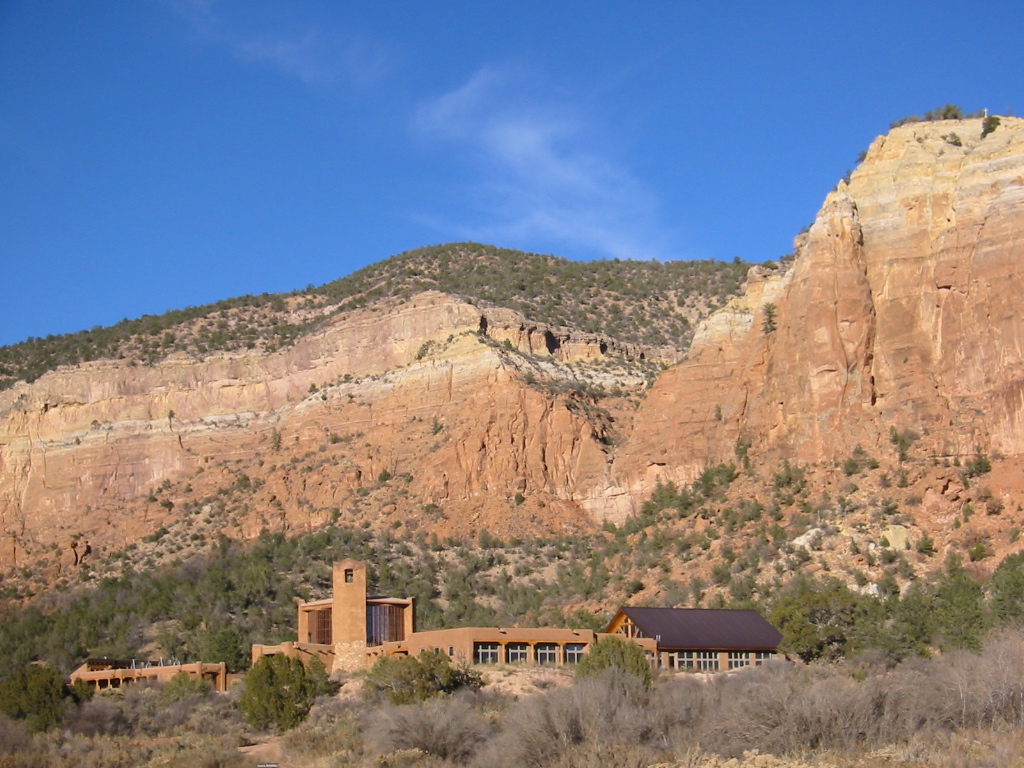
The Monastery of Christ in the Desert was founded in 1964 by Father Aelred Wall, who arrived in the remote canyon of the Chama River with a small group of monks from Mount Saviour Monastery in upstate New York. Sited roughly seventy-five miles north of Santa Fe at the end of Forest Service Road 151, the Benedictine foundation sits beneath sandstone cliffs in one of the most isolated stretches of northern New Mexico. The location was chosen deliberately for its silence and its harshness, conditions the founders considered essential to the contemplative life.
The chapel and associated monastic buildings were designed by the Japanese American woodworker and architect George Nakashima, better known for his furniture but trained in modernist architecture under Antonin Raymond. Nakashima's scheme adapts the regional adobe tradition to a restrained modern idiom. Thick earthen walls, finished in mud plaster, anchor the chapel to the canyon floor and provide the thermal mass needed to moderate the high desert's temperature swings. Above the walls, a steep timber roof and clerestory windows admit raking northern light, recalling both pueblo precedent and Nakashima's interest in Japanese spatial discipline. The campanile, a tapered adobe tower set apart from the chapel block, became the building's signature silhouette against the red cliffs.
The complex grew incrementally over the following decades as the community expanded. Additional cells, a refectory, a guesthouse, and workshops were added in compatible adobe construction, most of it shaped by the monks themselves with local labor. The monastery was received into the English Province of the Subiaco Congregation in 1983 and elevated to the status of an autonomous abbey in 1996. It remains entirely off the electrical grid, running on propane and solar power, with water drawn from the Chama.
Architecturally, the monastery is among the clearest expressions of modern-adobe practice in the American Southwest. It demonstrates how the unfired earthen wall, the defining material of New Mexican building since the seventeenth century, could be reconciled with mid-twentieth-century modernism without resorting to Pueblo Revival pastiche. The community remains active and cloistered, and access is limited to retreatants and pilgrims who travel the thirteen-mile dirt road into the canyon.
Notable features
- remote canyon setting along the Chama RiverModern Adobe
- adobe-modernist chapel by George NakashimaModern Adobe
- active Benedictine monastic communityModern Adobe
- off-grid: propane and solar powerModern Adobe
- limited public accessModern Adobe
Common questions
What is Christ in the Desert Monastery?
Christ in the Desert Monastery is an active Benedictine monastery in Abiquiu, New Mexico, founded in 1964 in a remote canyon of the Chama River roughly seventy-five miles north of Santa Fe. Its chapel and monastic buildings combine traditional adobe construction with mid-twentieth-century modernism.
When was Christ in the Desert Monastery built?
Christ in the Desert Monastery was founded in 1964 by Father Aelred Wall and a small group of monks from Mount Saviour Monastery in upstate New York. The complex was added to incrementally over the following decades and was elevated to the status of an autonomous abbey in 1996.
Where is Christ in the Desert Monastery located?
Christ in the Desert Monastery is located on Forest Service Road 151, Abiquiu, New Mexico 87510. It sits beneath sandstone cliffs in the Chama River canyon, reached by a thirteen-mile dirt road.
Can you visit Christ in the Desert Monastery?
Christ in the Desert Monastery remains an active cloistered community, and access is limited to retreatants and pilgrims who travel the thirteen-mile dirt road into the canyon. The monastery is off-grid, running on propane and solar power.
Who designed Christ in the Desert Monastery?
The chapel and associated monastic buildings at Christ in the Desert Monastery were designed by Japanese American woodworker and architect George Nakashima, better known for his furniture but trained in modernist architecture under Antonin Raymond.
Why is Christ in the Desert Monastery architecturally significant?
Christ in the Desert Monastery is among the clearest expressions of modern-adobe practice in the American Southwest. It reconciles the unfired earthen wall, the defining material of New Mexican building since the seventeenth century, with mid-twentieth-century modernism, featuring thick mud-plastered walls, a clerestoried timber roof, and a tapered adobe campanile.