Origins, defining traits, evolution
Spanish Colonial is the original colonial-era earthen building tradition of the American Southwest — the body of work produced between Juan de Oñate’s 1598 settlement of New Mexico and Mexican independence from Spain in 1821 — and is the source material that every later regional revival looks back to. It is the only American architectural tradition built continuously for more than two centuries before the United States existed.
Origins and range
The Spanish program in northern New Spain was settler-colonial and mission-based. From Santa Fe (founded 1610) west across the Rio Grande to Acoma and Zuni, south across the Jornada del Muerto to El Paso and on into the Sonoran missions, and east across what is now Texas to San Antonio (founded 1718), Spanish missionaries, presidio garrisons, and civilian settlers built in adobe because adobe was what the country yielded. The materials are local everywhere — clay, sand, straw, peeled pine for the roof, hand-quarried stone for the foundations. There is no timber-framed Spanish Colonial; the wall is the building.
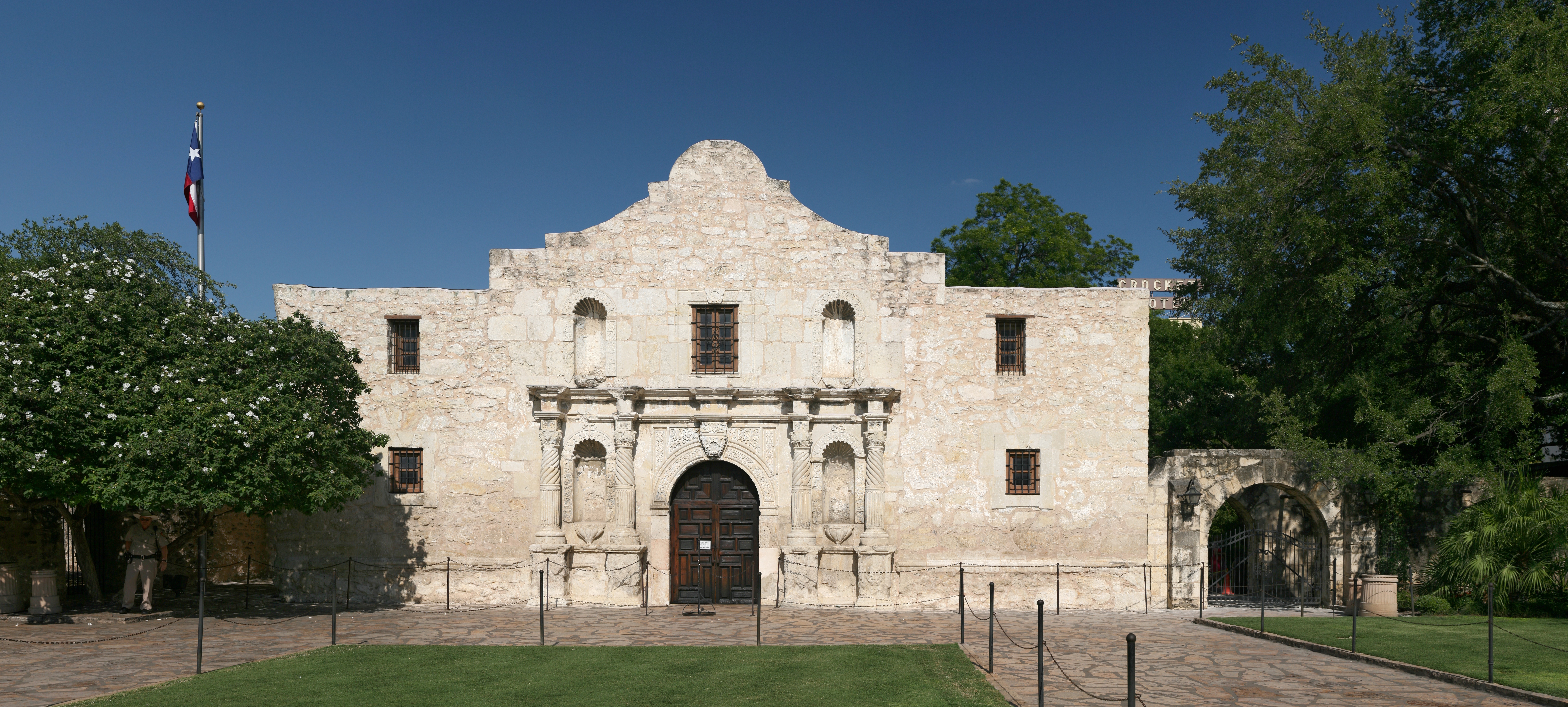
In California a parallel program ran later, from the first Franciscan mission at San Diego in 1769 to secularization in 1834. The California Spanish Colonial tradition shares the same wall section and the same courtyard plan but produces more elaborate church facades and more theatrical interiors, owing to a richer mission economy and a later, more Baroque source vocabulary. The Texas missions occupy a third pole, with San Antonio’s five missions — the Alamo among them — built from local limestone faced with adobe coursing in places where adobe alone could not span.
Defining features
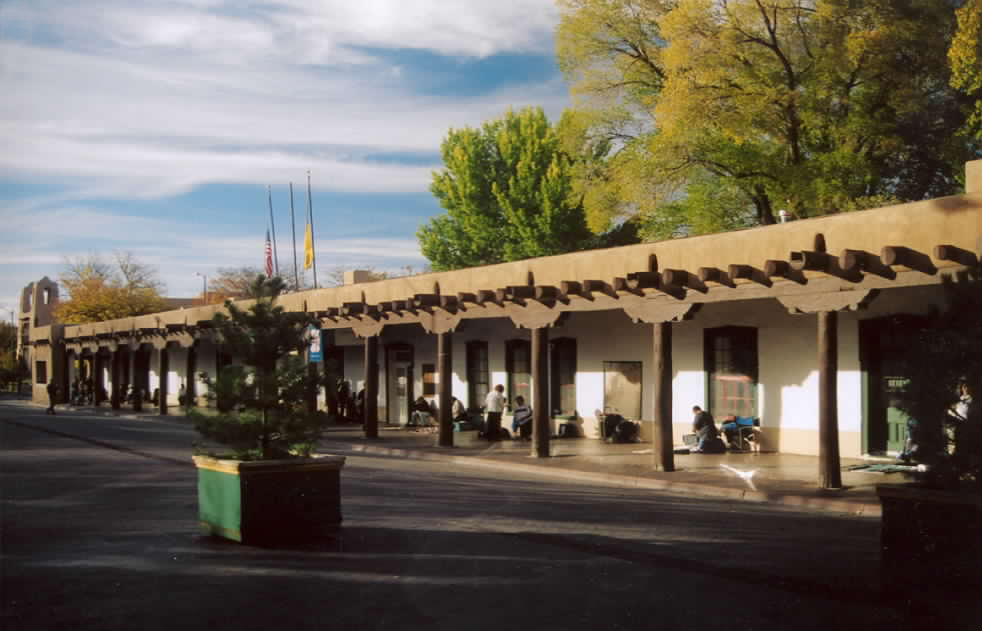
A Spanish Colonial building is recognizable by what it lacks as much as by what it has. Walls are massive load-bearing adobe, two to three feet thick on a stone or rubble foundation, with rounded corners and a hand-troweled mud-plaster finish. The plan is single-story, organized around an interior placita courtyard onto which rooms open through deep, low doorways. The exterior, by contrast, is closed: few windows, small in scale, set in deeply splayed reveals, often grated with hand-turned wooden bars or wrought-iron rejas. The Palace of the Governors in Santa Fe — built 1610 and continuously occupied since — is the canonical civilian example.
Roofs are flat. They are framed with round timber vigas, decked with split-cedar latillas or sometimes hand-laid willow, and surfaced with several inches of compacted earth pitched gently toward wooden canale drain spouts that project through the parapet. There are no sloped roofs in pre-1846 New Mexico adobe construction. The flat roof is diagnostic.
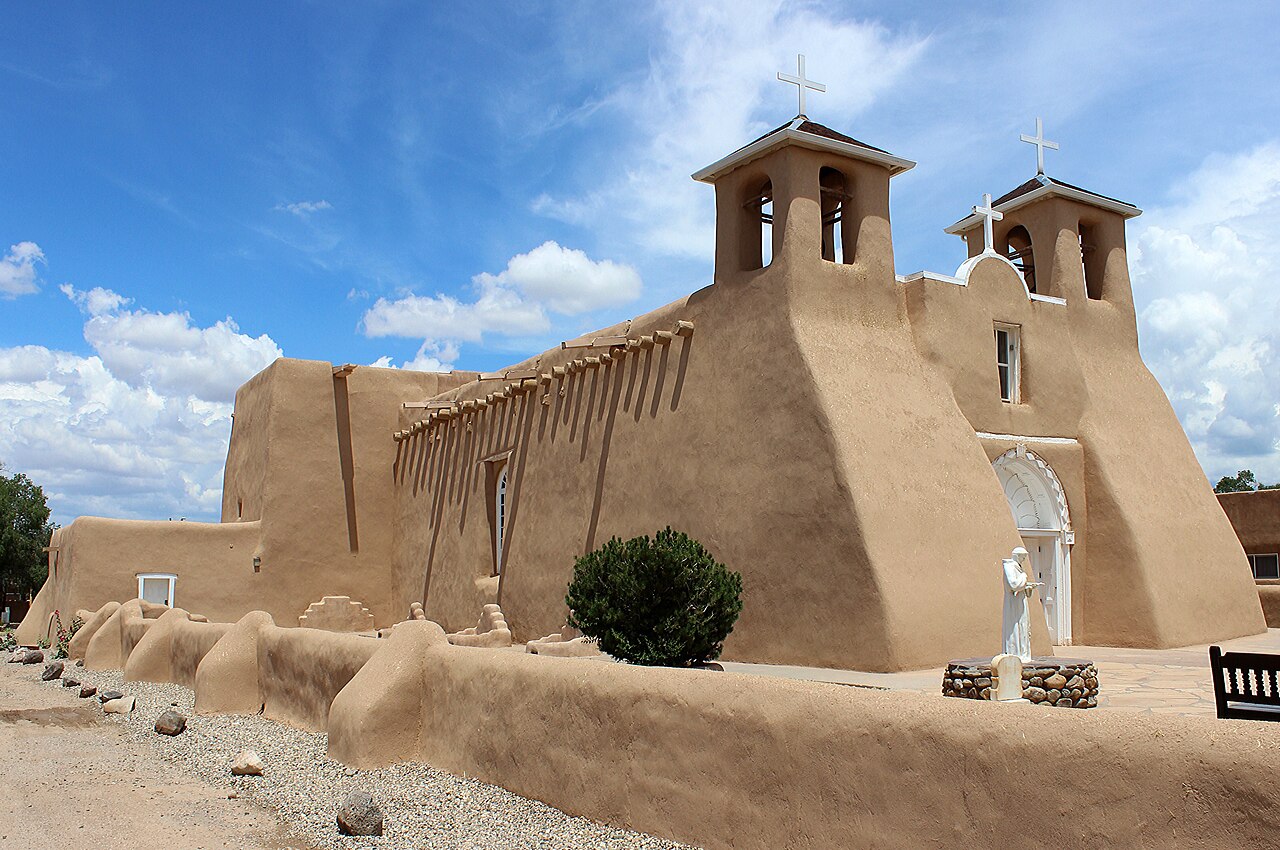
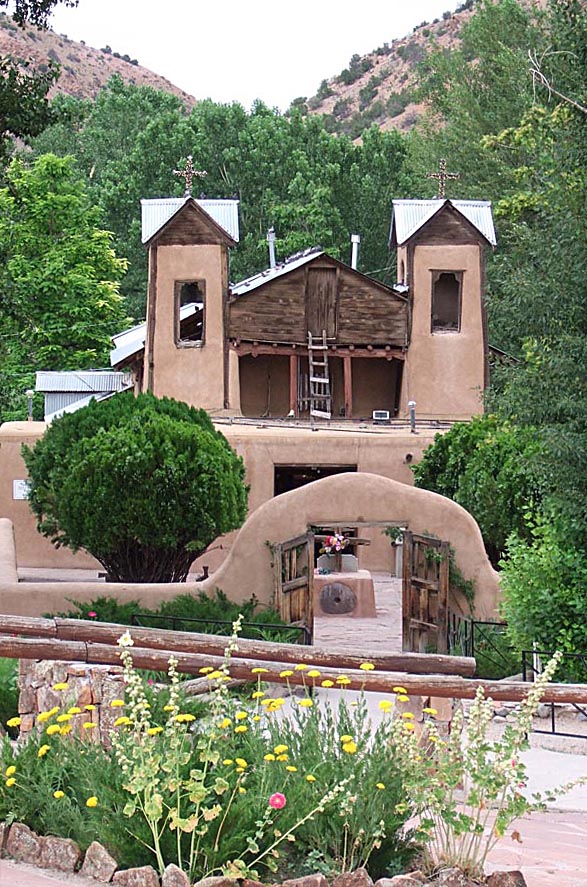
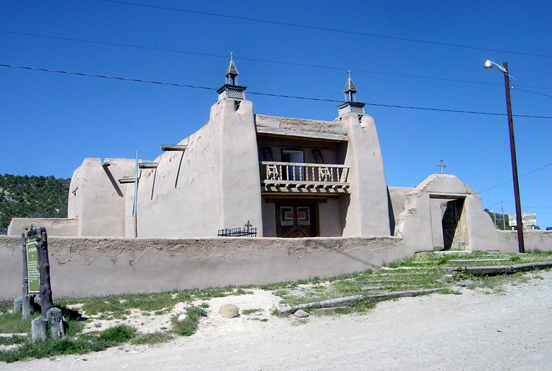
A long covered portal — supported by hand-hewn pine posts with carved zapata corbel brackets and a simple wooden lintel — wraps one or more sides of the building, facing the placita inside and sometimes the plaza outside. The portal does double duty as a shaded breezeway and as the principal circulation between rooms (interior corridors do not exist in this tradition). The San Francisco de Asís Mission Church at Ranchos de Taos (1816) and El Santuario de Chimayó (1816) are the great church examples in northern New Mexico; San José de Gracia at Las Trampas (1760) is the purest surviving rural parish.
Regional variation
Three regional inflections distinguish the tradition. The New Mexican variant, which produced the largest surviving body of work, is austere and earthen: undecorated mud-plaster walls, plain wooden doors, no applied ornament. The California variant — visible at the missions and at later rancho adobes — is whitewashed inside and out, employs more carpentry (turned balusters, paneled doors, glazed sash), and after 1820 begins to acquire tile roofs in a hybrid known as Monterey Colonial. The Texas variant is the most Baroque of the three, with carved limestone facades on the principal church fronts at San Antonio (the Alamo, Mission San José) and a more sophisticated mortared-stone discipline behind the adobe surfaces.
Materials and construction
The Spanish Colonial wall section is the simplest in the catalog. Hand-molded sun-dried bricks, roughly 10 by 14 by 4 inches, are laid in mud mortar on a stone or rubble foundation that lifts the first course six to twelve inches above grade. Walls climb to about ten feet at the eave; the rooms inside are usually fifteen to eighteen feet across (the practical span of an undimensioned viga in country pine). Plaster is mud — a clay-and-straw slurry — re-coated every two or three years on a maintained building. Whitewashed lime plaster appears in California and on the more ambitious New Mexican church interiors but is the exception, not the rule.
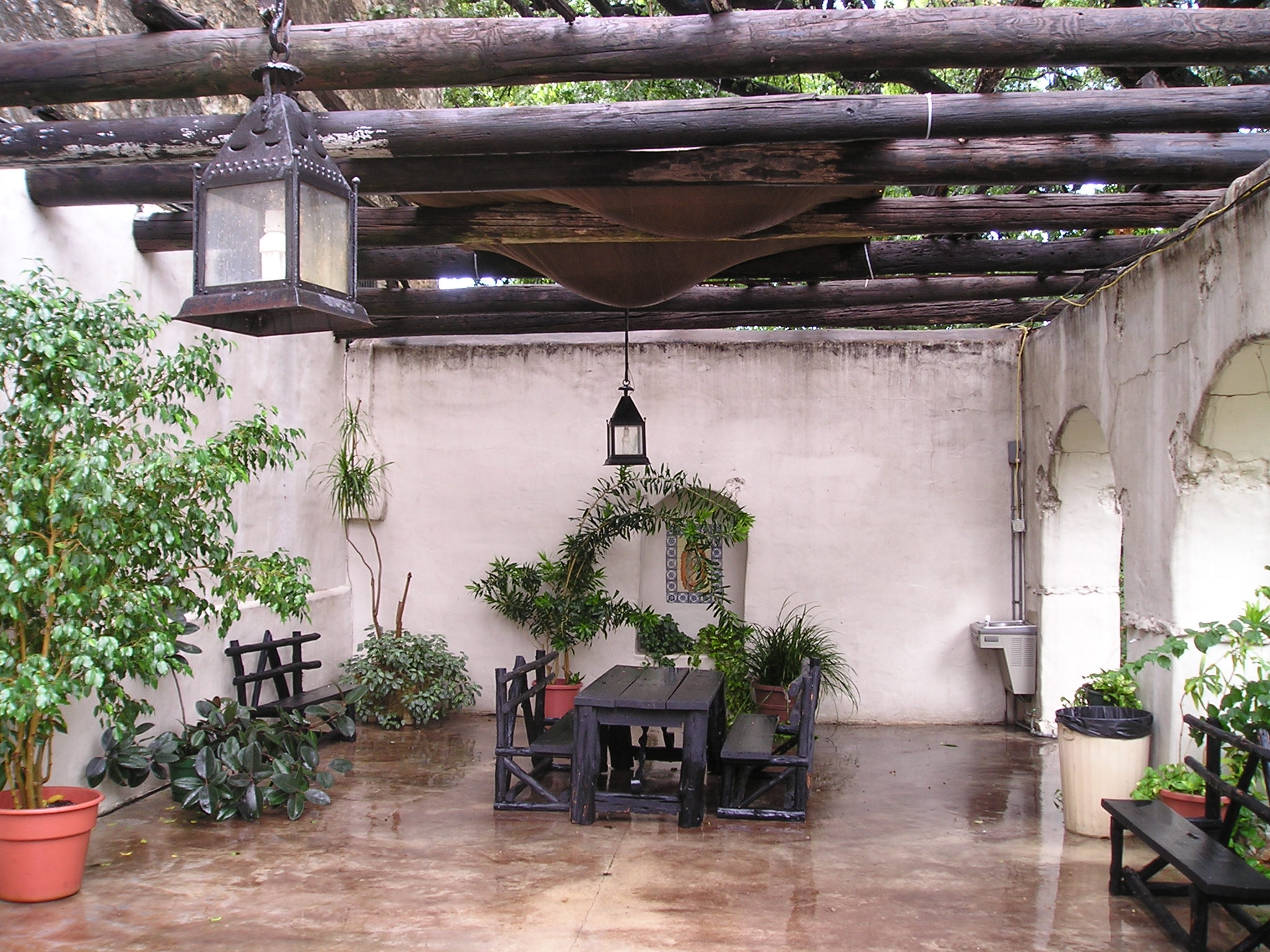
Roof framing is direct. Peeled pine vigas, eight to twelve inches in diameter, are laid across the room on top of the wall, projecting slightly through the front and rear walls. Split-cedar or aspen latillas are laid herringbone across the vigas. Several inches of brush and bark go down, and several more inches of compacted earth go on top. Canales — open wooden box drains, hollowed from a half-log or built up from plank — project through the parapet at the low corners of the roof.
Restoration considerations
The Spanish Colonial inventory is the most fragile in the country because its earliest examples are also its most heavily restored. The Palace of the Governors was substantially rebuilt in 1909–13 under Jesse Nusbaum and again in 1969–72; very little of its visible fabric is colonial. The Ranchos de Taos church has been re-plastered, by hand, every two years by the parish since at least the 1830s. The discipline is mud plaster, kept on, maintained on a working schedule, with the canales draining and the base of the wall dry. Cement stucco is the principal threat to surviving Spanish Colonial fabric and should be removed wherever it has been applied. Original vigas, where they survive, should be left in place and end-sealed; replacements should be of the same diameter and species, hand-peeled.
Identification key
7 diagnostic features. A building showing four or more, in combination with regional context, can be confidently identified as Spanish Colonial.
Notable examples
A representative selection drawn from the Atlas — the strongest surviving demonstrations of the Spanish Colonial idiom. Click any plate for the property's full catalog page.