Origins, defining traits, evolution
Pueblo Revival is a regional revival style of the American Southwest that borrows the visual language of the Ancestral Puebloan and Spanish-Pueblo building traditions — thick earth-toned walls, flat parapeted roofs, projecting roof timbers, and softly rounded corners — and applies it to civic, institutional, commercial, and domestic buildings constructed largely after 1900. It is the most consistently recognizable American architectural style of the twentieth century outside its eastern heartland, and the only one in the country with statutory force in its home city.
Origins
The style is not a survival but a deliberate revival. Its origin is conventionally dated to 1898, when William G. Tight became president of the University of New Mexico and ordered the campus’s existing brick Romanesque buildings refaced in the manner of nearby Acoma and Taos pueblos. Hodgin Hall, completed in its remodeled form in 1908, is the inaugural example. Architect Edward Buxton Cristy designed the early UNM campus expansion in the new manner; the style was given its mature urban form a decade later in Santa Fe.
In 1912 the city of Santa Fe, then in commercial decline after being bypassed by the Atchison, Topeka and Santa Fe Railway, adopted what it called the “Santa Fe Style” as official city policy. Sylvanus Morley, Jesse Nusbaum, Carlos Vierra, and Frank Springer drafted a New-Old Santa Fe Exhibition that pictured the city as it might appear if rebuilt in the manner of its surviving Spanish-Pueblo blocks. The 1917 reconstruction of the Palace of the Governors, the 1922 La Fonda hotel, and the 1923 New Mexico Museum of Art are the canonical demonstrations.
The defining figure of the style’s second generation is the architect John Gaw Meem, who arrived in Santa Fe in 1920 as a tuberculosis patient and stayed to design the Cristo Rey Church (1940, then the largest adobe structure in the United States), Zimmerman Library at UNM (1938), La Fonda’s 1929 expansion, and roughly two hundred other buildings across the Southwest. Meem treated the style as a living regional grammar rather than a pastiche, and his work establishes the second canon after the first generation’s archaeological one.
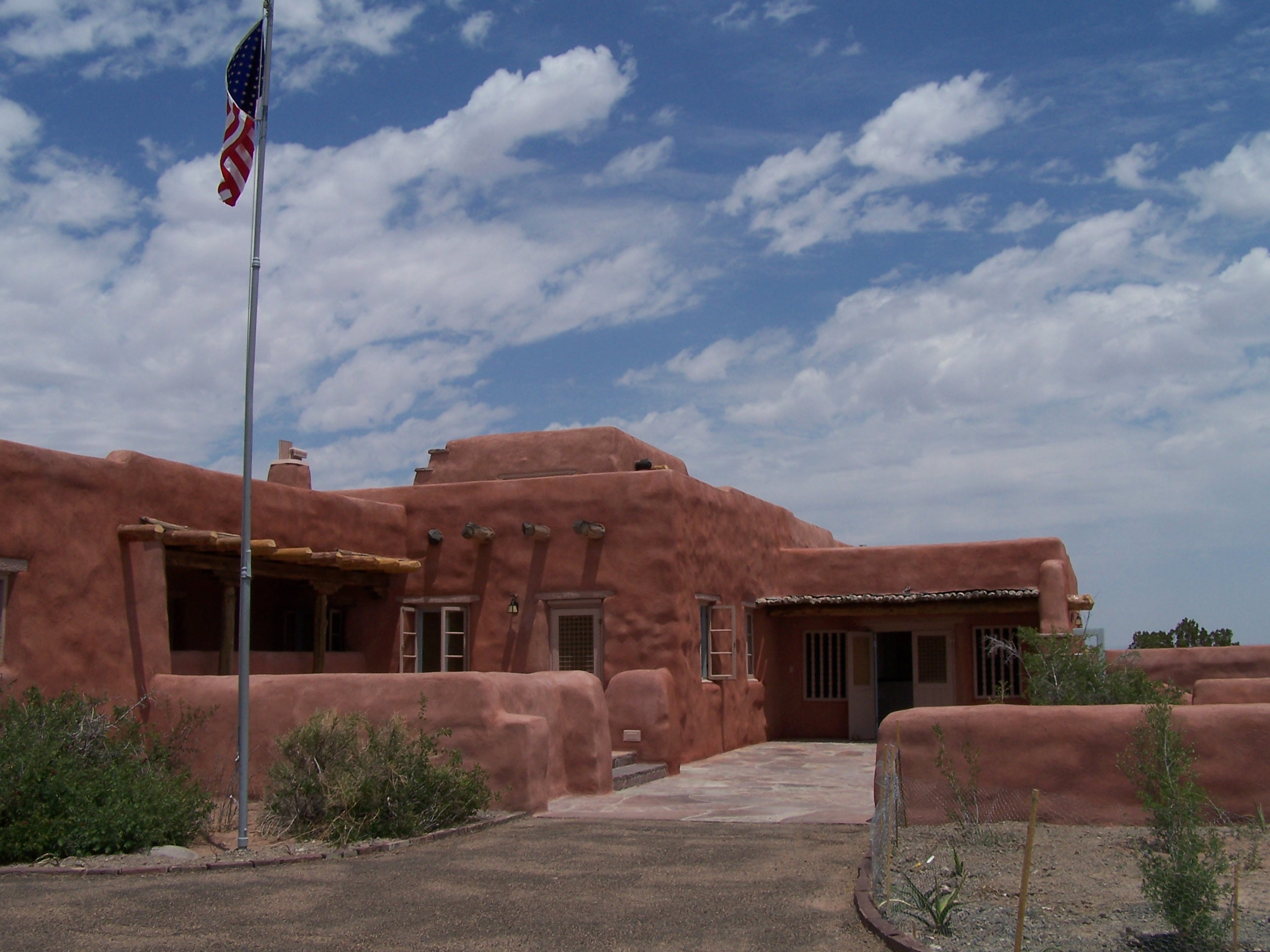
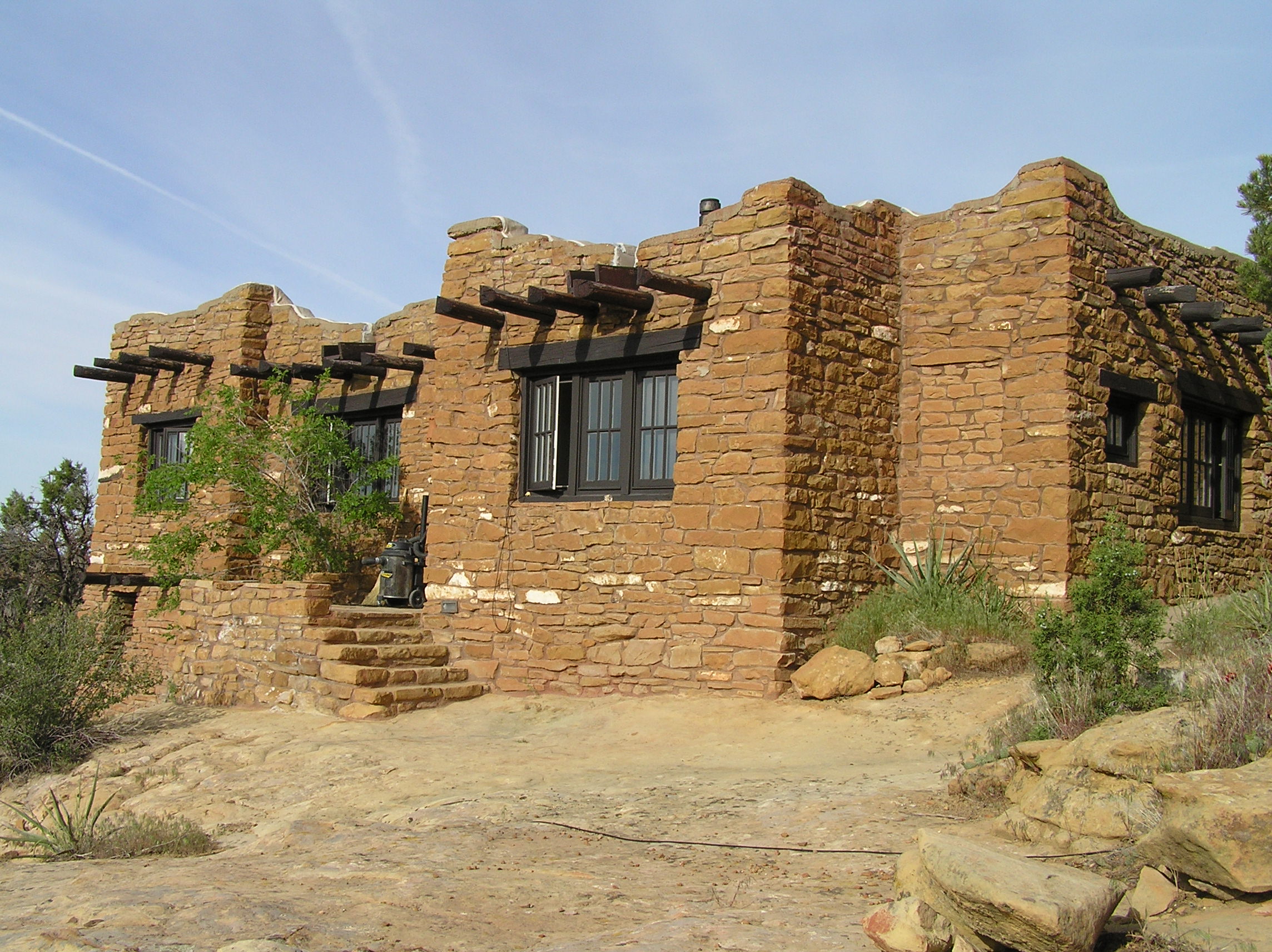
A second important hand is Mary Colter, who worked for the Fred Harvey Company at the Grand Canyon and along the rail lines. The Painted Desert Inn (rebuilt in its mature Pueblo Revival form in 1940), Hopi House (1905), Hermit’s Rest (1914), and Desert View Watchtower (1932) draw on the same source material but with a frankly picturesque, theatrical inflection — they are buildings designed to be photographed by railway passengers. Colter’s structures are properly classified within the Pueblo Revival family and are diagnostic of its commercial wing.
Defining material features
A mature Pueblo Revival building shows four or five of the following at once: massive walls finished in earthen or warm stucco; a flat roof concealed behind a low parapet whose corners are softened or stepped; round timber vigas projecting through the wall at the roofline; wooden drainage spouts (canales) projecting at intervals from the parapet; deep-set window and door reveals; and a covered porch — a portal — supported by carved wooden posts and lintels (zapatas and corbels). Interiors typically carry exposed vigas with a ceiling of split saplings — latillas — laid herringbone above them.
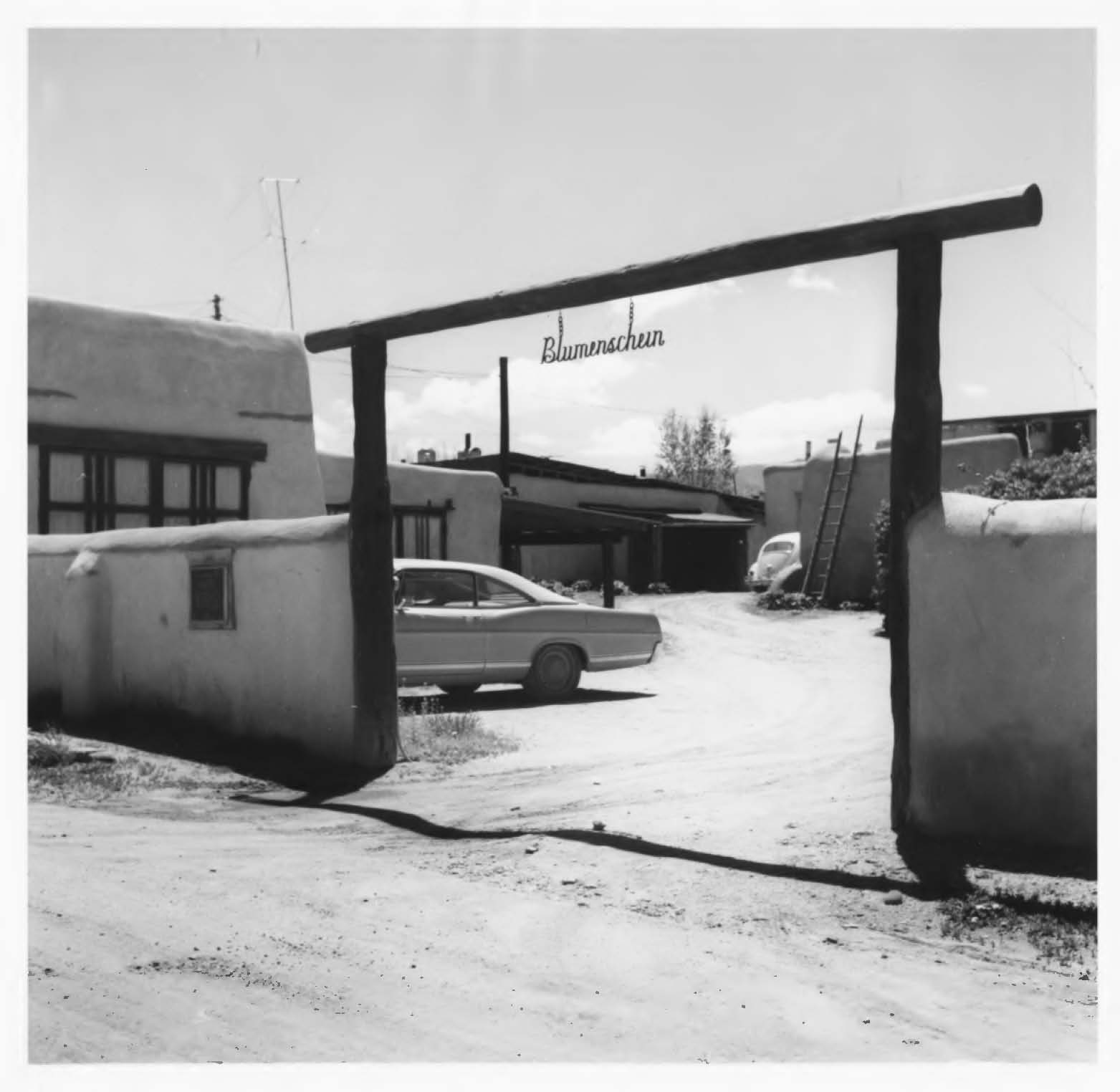
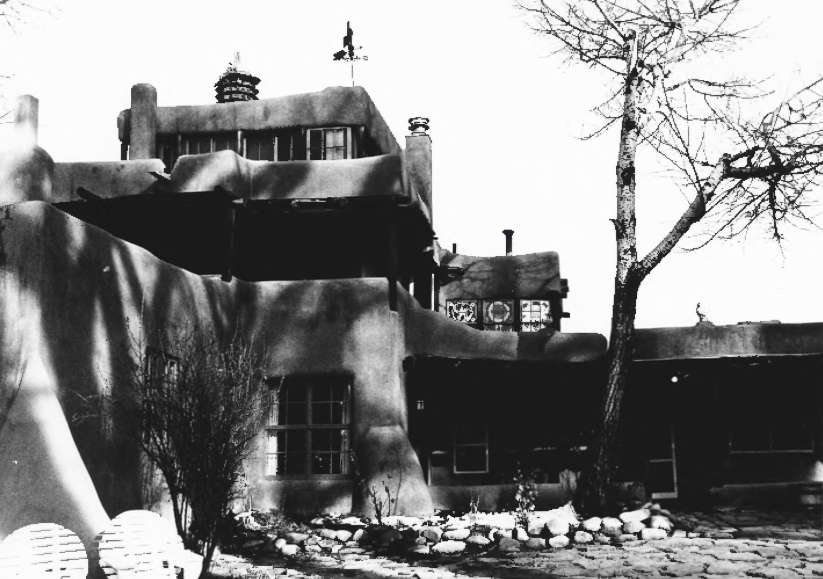
The Ernest L. Blumenschein House in Taos, built in stages around an older adobe core and rebuilt extensively by Blumenschein after 1919, is the canonical small-scale example: a dim portal, a viga-roofed studio, and the soft rounded walls a generation of painters came to Taos to see. The Mabel Dodge Luhan House nearby, expanded by Tony Lujan after 1918, is the same idiom enlarged into a salon. Both are National Historic Landmarks today.
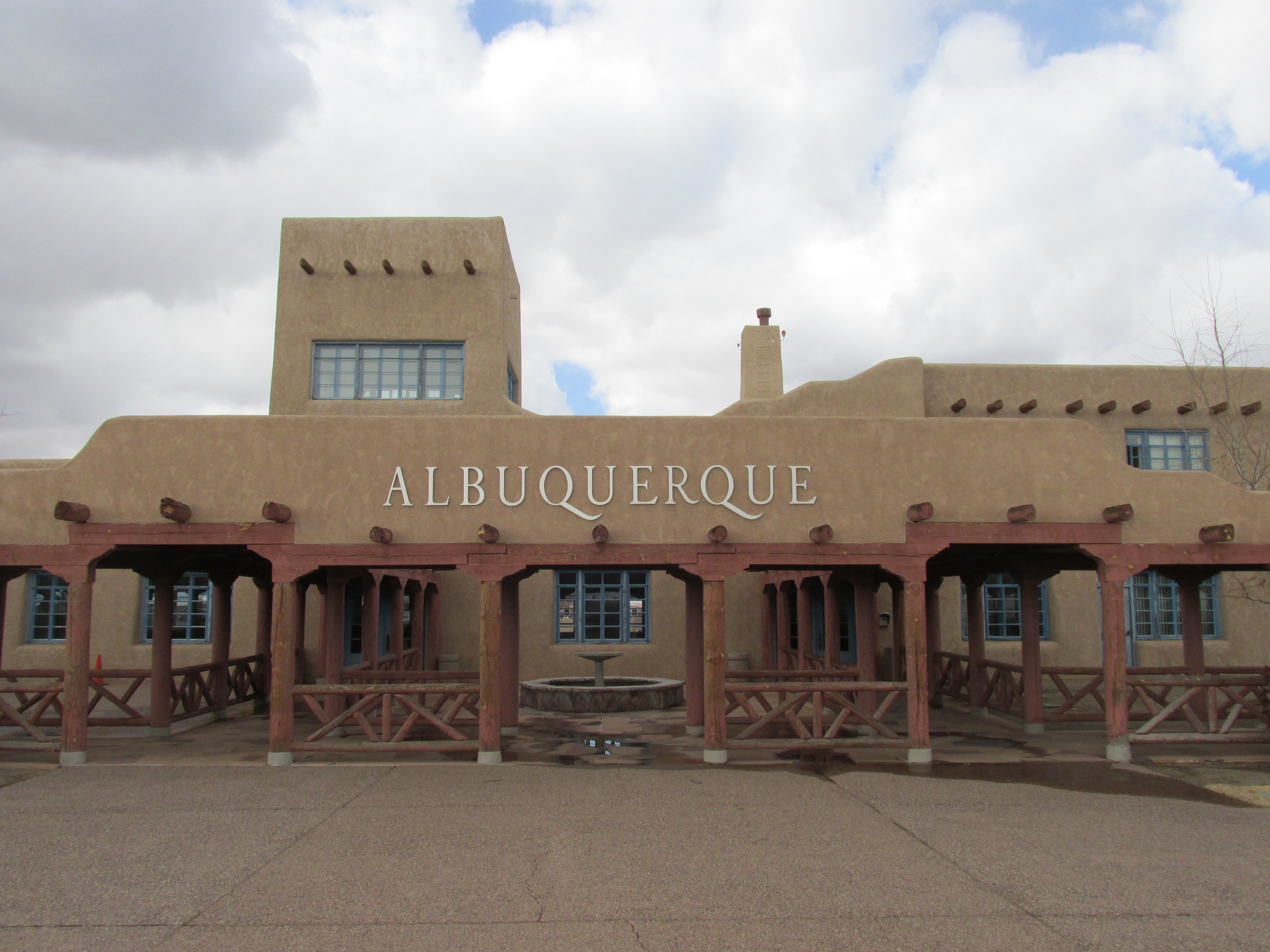
What the style is not, materially, is a guarantee of adobe construction. After about 1925 a Pueblo Revival building is as likely to be hollow tile, poured concrete, or wood frame, stuccoed to read as adobe. The 1939 Albuquerque Municipal Airport Building, often cited as the high-water mark of the civic style, is a steel-frame structure with stucco on metal lath. This is not a deception so much as a regional convention: the visual grammar is the style, not the wall section.
Regional variation
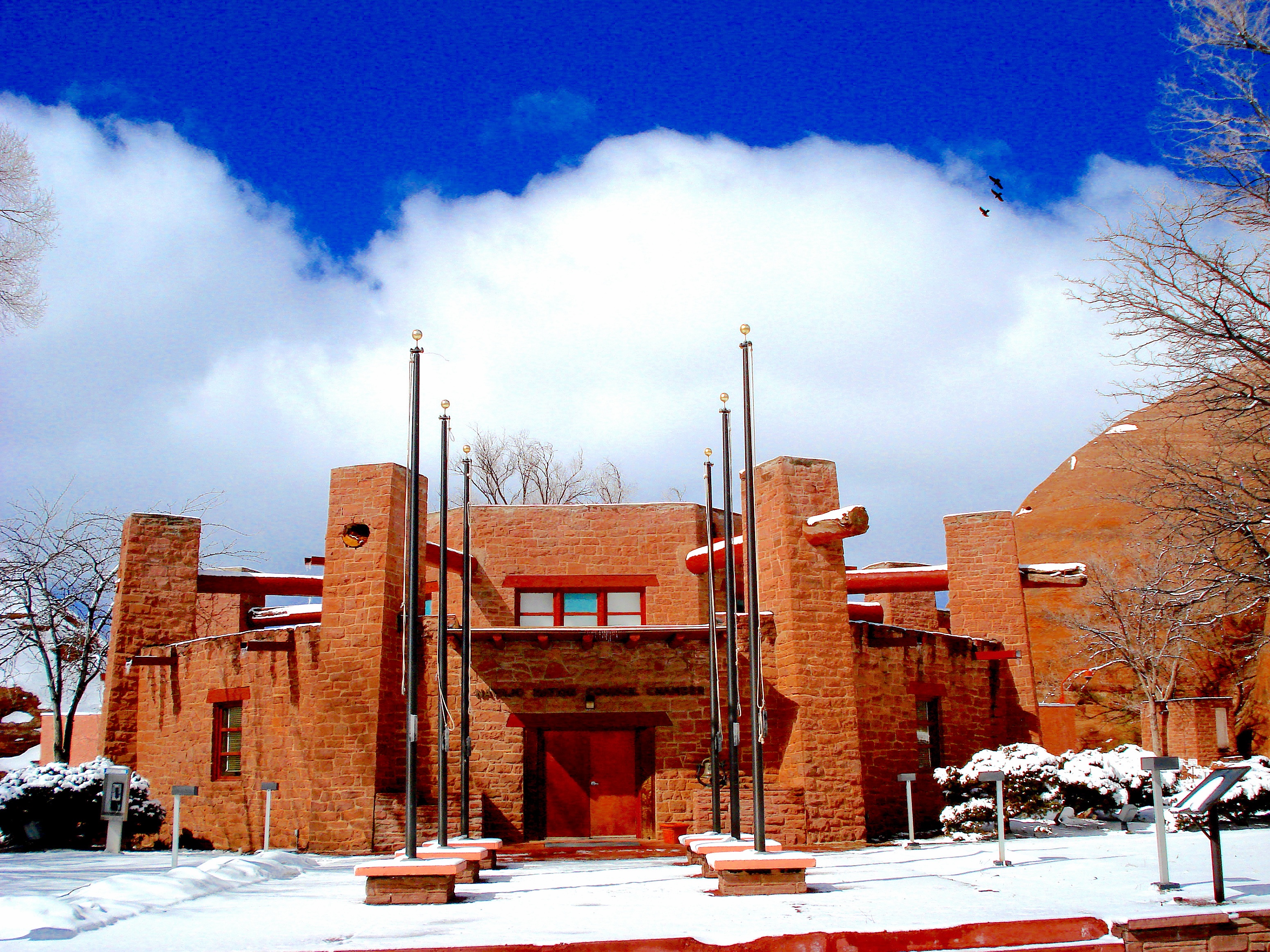
Three regional inflections distinguish the field. The Santa Fe variant — the canonical urban form — favors a fully enclosed parapet with subtle stepping, a long deep portal, and zapatas of carved cottonwood. The Taos variant, visible at Blumenschein and Luhan, is more sculptural and irregular, with deeper setbacks and a more massed silhouette derived from Taos Pueblo itself. The Arizona inflection, visible at the Painted Desert Inn and the Navajo Nation Council Chamber in Window Rock, is harsher and more theatrical — built often by the National Park Service or Indian Service on remote sites, and reading more like archaeological reconstruction than civic architecture. The Mesa Verde Administrative District in southern Colorado preserves the National Park Service version of the same idiom.
Materials and construction
Through about 1930 the standard wall section is adobe: hand-molded sun-dried bricks, roughly 10 by 14 by 4 inches, laid in mud mortar on a stone or rubble foundation, with walls 18 to 30 inches thick. Roofs are flat, framed with peeled pine vigas spanning between the load-bearing walls, decked with peeled aspen or cedar saplings (latillas) laid herringbone above the vigas, and covered with several inches of compacted earth pitched gently toward the canales. Plaster is mud — a clay-and-straw slurry — re-coated every few years on a maintained building.
After about 1930 the wall section opens out. Hollow clay tile, terracotta block, lightweight concrete masonry, and stuccoed wood frame all substitute for adobe brick in the body of the wall, with the diagnostic features — the parapet, the vigas, the canales, the deep reveals — applied as a surface program over a conventional structural shell. By 1950 most new Pueblo Revival construction in Santa Fe and Albuquerque was of this hybrid type.
Evolution
Three phases are distinguishable. The first, from about 1908 to 1920, is archaeological — buildings closely model specific surviving precedents (Acoma, Taos, the Palace of the Governors). The second, the Meem phase from about 1920 to 1950, generalizes the style into a flexible regional language applicable to libraries, churches, schools, and dormitories. The third, from about 1950 onward, is the domestic commercial phase: the style passes into the speculative housing market, where it generates the ubiquitous flat-roofed stucco house — vigas optional — that defines the post-war Santa Fe and Albuquerque suburbs. Modern adobe and the “Northern New Mexico” subtype are descendants of this third phase.
Pueblo Revival is also a protected style in three jurisdictions. The Santa Fe Historic District, the Taos Historic District, and parts of central Albuquerque enforce design ordinances that require parapets, earth-tone stucco, and concealed flat roofs on new construction. It is the only American architectural style with statutory force in its home city.
Restoration considerations
Original adobe Pueblo Revival fabric is fragile in only one direction: water. A maintained mud-plastered building lasts indefinitely; a building whose plaster has cracked and whose canales are blocked can lose a wall in a single wet winter. The restoration discipline is therefore monotonous. Keep the plaster intact. Keep the canales draining. Keep the base of the wall dry. Modern lime-stabilized stucco can substitute for traditional mud plaster but must remain breathable; impermeable cement stuccoes have destroyed more historic adobe than fire has. Vigas are end-grain-exposed and the most common point of progressive failure; a viga showing soft rot through its first inch should be flashed and end-sealed before the next freeze-thaw cycle. The mass walls themselves, kept dry, will outlast everything around them.
Identification key
8 diagnostic features. A building showing four or more, in combination with regional context, can be confidently identified as Pueblo Revival.
Notable examples
A representative selection drawn from the Atlas — the strongest surviving demonstrations of the Pueblo Revival idiom. Click any plate for the property's full catalog page.