Origins, defining traits, evolution
Territorial is the hybrid style of the New Mexico Territory period — the years between the American annexation of the Southwest in 1846 and New Mexico’s admission to statehood in 1912 — in which adobe construction is fitted out with American Greek Revival millwork carried in by the wagon trains. It is the visible record of one building tradition absorbing another without abandoning it, and its survivors are the most precisely datable adobe buildings in the country.
Origins
Territorial begins materially with the opening of the Santa Fe Trail to American freight in 1821 and politically with the U.S. military occupation of New Mexico in August 1846. The Mexican-American War redirected the trade in milled lumber, sash glass, fired brick, paint, and turned newel posts that had previously moved south from Independence, Missouri to Chihuahua; after 1846 those goods landed at Fort Union and Santa Fe instead. Within a decade adobe builders along the Rio Grande were ordering milled pine porch posts, double-hung sash, and paint pigments from St. Louis catalogs and applying them to wall sections that had not otherwise changed since the Spanish period.
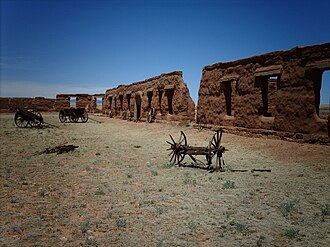
The result is a style with a sharply defined identity: the wall is still adobe, the roof is still flat, the floor plan is still a placita courtyard. But the parapet now carries a course of fired brick coping in a crisp horizontal stripe; the windows are now squared-off double-hungs with pedimented white-painted trim; the porch posts are now milled lumber with chamfered or turned profiles; and the front door is now a paneled American door inside a Greek Revival surround. Fort Union, built in 1851 as the principal U.S. Army supply depot for the Southwest, is the canonical military example. The Double Eagle Restaurant building in Mesilla preserves the canonical civilian one.
Defining features
A Territorial building is unmistakable to a sidewalk reader once the two essential tells are recognized. First, the parapet. A Spanish Colonial or Pueblo Revival parapet is soft, brown, and continuous with the wall below. A Territorial parapet is capped — almost always — with a single course of red fired brick laid flat or in a sawtooth pattern, producing a hard horizontal line at the top of an otherwise earthen wall. The brick course is decorative; it does not carry load. It is there because it can be there, and because it announces the building’s date to the period eye.
Second, the windows. A Spanish Colonial window is small, deep, and undecorated. A Territorial window is enlarged to take a standard pair of double-hung sash, set behind a heavy wooden frame trimmed with milled boards painted white. The trim is often pedimented — a flat triangular cap above the head jamb, sometimes with a simple denticulate frieze — in direct quotation of small-town Greek Revival from Ohio and Indiana. Two or three white-painted pedimented windows in a brown adobe wall are diagnostic.
A Territorial portal — when present — replaces the Spanish Colonial’s hand-hewn pine posts and zapatas with milled, chamfered, sometimes turned posts capped with a simple bracket. The roof of the portal is still flat (a pitched roof is a post-1900 modification on any genuine Territorial building) and the vigas are still present but increasingly hidden behind a boxed wooden cornice.
Regional variation
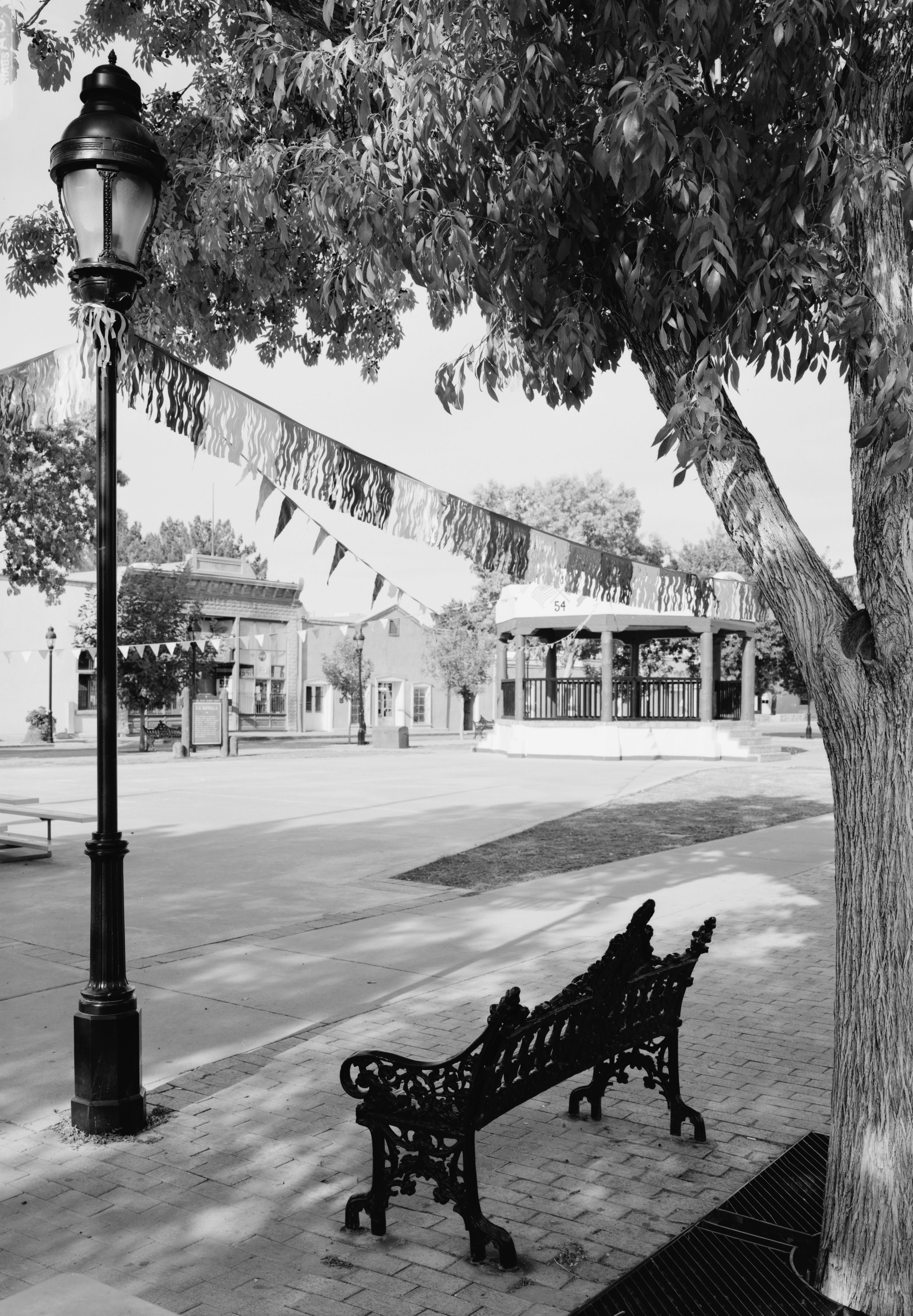
Territorial is largely a New Mexico style, with a tighter geographic range than either Spanish Colonial or Pueblo Revival. Its heartland is the Rio Grande corridor from Las Vegas, New Mexico south to Mesilla and Las Cruces, with significant outliers at Santa Fe and Albuquerque. Outside New Mexico the style is occasional rather than systematic — there is some Territorial work in Tucson and along the Santa Fe Trail in southern Colorado, and the Fort Union military pattern shows up at other Southwestern frontier posts, but the full domestic vocabulary belongs to New Mexico.
A revival of the style — Territorial Revival — appeared in Santa Fe around 1930 as an alternative to Pueblo Revival, championed by John Gaw Meem in a small number of houses and offices. Territorial Revival examples can be distinguished from genuine Territorial work by their more elaborate millwork, their use of larger window openings, and their occasional use of brick (rather than adobe) for the body of the wall.
Materials and construction
The Territorial wall section is identical to the Spanish Colonial wall section — adobe brick, mud mortar, mud plaster, peeled pine vigas, latilla deck, earthen roof — with three additions. First, a course of fired brick is laid along the top of the parapet, bedded in lime mortar. The brick is locally fired at small kilns along the Rio Grande after about 1850. Second, milled lumber is used for porch posts, window and door trim, and the boxed cornice that hides the vigas. The lumber arrives down the Santa Fe Trail. Third, sash glass — single-pane through about 1860, then increasingly multi-pane — replaces the Spanish Colonial’s small wooden grilles in the windows.
The result is a wall that reads as half-adobe and half-millwork, and that is exactly what it is. The earthen body provides the thermal mass, the load-bearing capacity, and the sense of place; the carpentry overlay provides the date.
Restoration considerations
Territorial buildings have the same maintenance regime as Spanish Colonial — keep the mud plaster on, keep the canales draining, keep water away from the wall base — with one addition. The brick coping at the parapet is the joint at which the most water enters a Territorial wall. The mortar between brick courses fails before the brick does, and a failed coping joint will route rainwater straight down the inside face of the parapet and into the wall. The single most important preservation discipline on a Territorial building is to repoint the brick coping every fifteen or twenty years in lime mortar — never in Portland cement.
The white-painted millwork is also fragile. Original paint layers contain lead and are part of the building’s documentary record; they should be stabilized rather than stripped where possible. Replacement millwork should match the original profiles precisely; the chamfered porch post and the pedimented window cap are the signatures of the style, and a wrong profile reads instantly as a renovation.
Identification key
6 diagnostic features. A building showing four or more, in combination with regional context, can be confidently identified as Territorial.
Notable examples
A representative selection drawn from the Atlas — the strongest surviving demonstrations of the Territorial idiom. Click any plate for the property's full catalog page.