Origins, defining traits, evolution
Modern Adobe is the post-1950 continuation of the New Mexico earthen building tradition under modern building codes, engineered structure, and contemporary energy expectations. It is at once the most recent style in this catalog and the only one in which adobe construction continues to be permitted as a primary wall system on new buildings. Its great works are still being built.
Origins
Modern Adobe begins administratively rather than aesthetically. The Pueblo Revival had by 1950 reduced adobe from a load-bearing material to a surface program: most “adobe” buildings going up in Santa Fe after the war were wood frame or hollow tile, stuccoed to read as earthen. Modern Adobe is the reaction against that reduction. A small group of New Mexico architects and builders — among them the team around Bainbridge Bunting at the University of New Mexico, and the engineer-builder Paul Graham McHenry — set out to bring adobe back as a true structural material by adapting it to modern code requirements.
The technical program had three parts. First, stabilize the brick. A small fraction of asphalt emulsion or hydrated lime mixed into the adobe slurry makes the cured brick substantially more water-resistant without compromising its breathability. Stabilized adobe became code-approved in New Mexico in the early 1950s and is now the dominant new-adobe form. Second, reinforce the wall. A continuous reinforced-concrete bond beam at the top of every adobe wall ties the building together against seismic and wind loads, and concrete footings carry the wall below the frost line. Third, engineer the openings. Window and door bucks are sized to standard millwork, and lintels are reinforced concrete or steel.
The result is a wall section that looks Spanish Colonial from outside — soft mud-plastered surfaces, deep reveals, viga ceilings — but is engineered to current code and will pass any inspector in any jurisdiction.
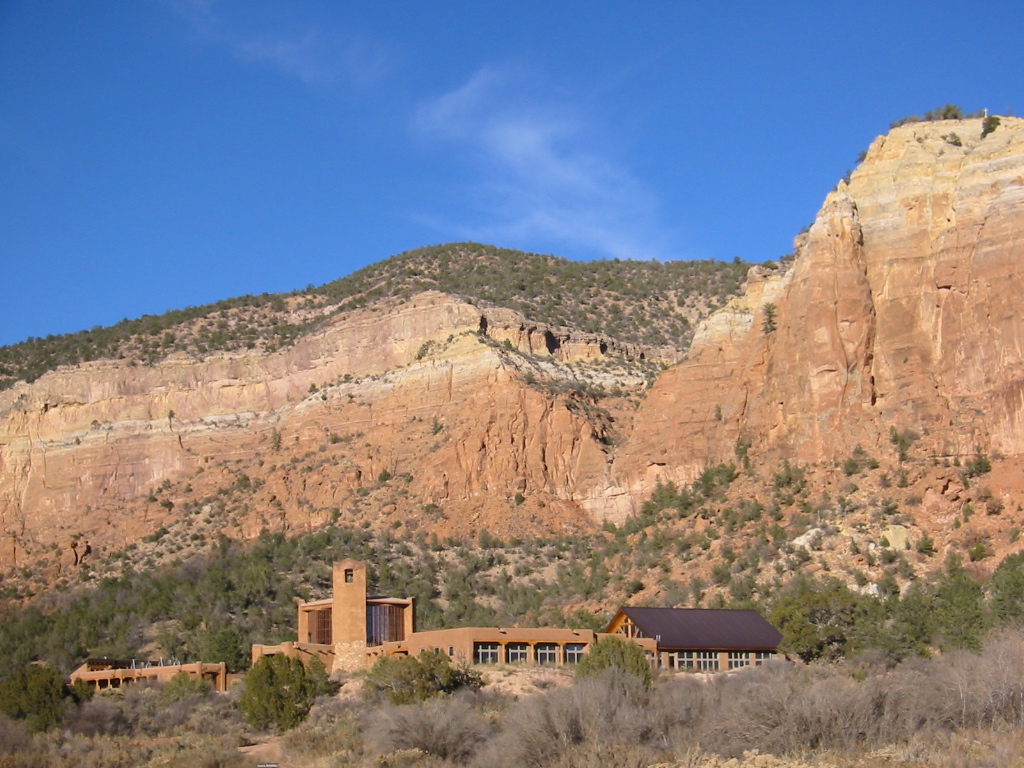
The Christ in the Desert Monastery near Abiquiu, designed by George Nakashima for the Benedictine community and built in stages from 1970 onward, is the canonical contemporary religious example: stabilized adobe walls, exposed bond beam, viga roof, and a chapel whose interior is the cleanest available expression of what modern earthen building can do at scale.
Defining features
A Modern Adobe building can be recognized by what it adds to the traditional vocabulary rather than what it changes. The visible surface remains within the Spanish Colonial / Pueblo Revival family — flat roofs, parapets, vigas, canales, deep reveals, earth-tone stucco. What is added is structural and environmental.
The continuous concrete bond beam at the top of the wall is the single most reliable diagnostic, but it is often hidden behind a parapet or below a fascia. The deep south-facing window walls — passive-solar glazing meant to charge the thermal mass of the floor and the back wall on winter mornings — are more visible and more diagnostic in any building post-1975. The interior wall surfaces, often left as bare stabilized adobe or finished only in a thin lime wash, are the third diagnostic: in a Spanish Colonial or Pueblo Revival interior the walls are mud-plastered, in a Modern Adobe interior they are frequently the brick face itself.
Regional variation
Modern Adobe is overwhelmingly a New Mexico style, but it has produced a small but coherent body of work in Arizona, southern Colorado, west Texas, and the high desert of California. Outside the Southwest the tradition is occasional rather than systematic — there is some adobe building in the Pacific Northwest cob-and-strawbale community, but it does not carry the same architectural vocabulary.
A regional subtype, “Northern New Mexico,” combines stabilized adobe walls with low-pitched metal roofs (rather than flat earthen roofs) and is the dominant new-construction vernacular along the high Rio Grande corridor between Santa Fe and Taos. It is properly classified as a hybrid of Modern Adobe and the territorial pitched-roof tradition.
Materials and construction
A Modern Adobe wall is laid up from stabilized adobe brick — hand-molded or factory-cast, with about three to five percent asphalt emulsion mixed into the clay slurry — on a continuous reinforced concrete footing carried below the local frost line. Walls are typically 12 to 14 inches thick (down from the 18 to 30 inches of Spanish Colonial construction) and rise to a reinforced concrete bond beam at the top of the wall, which carries the roof framing and ties the corners together. Roof framing remains visible vigas where the design permits, but is often dimensional lumber or trusses concealed above a viga-style ceiling.
Plaster is either traditional mud, lime-stabilized stucco, or in some recent work a synthetic acrylic stucco. The acrylic finishes are not breathable and are not recommended; lime-stabilized and traditional mud finishes both work well over stabilized adobe brick.
Restoration considerations
Modern Adobe buildings are too young to have entered the historical preservation system in any substantial way, and most are still in their first owner’s hands. The maintenance discipline is the same as for the older traditions — keep the plaster intact, keep water moving away from the base of the wall, keep the canales draining — with the additional concern that some early Modern Adobe walls were finished in Portland cement stucco before the breathability problem was widely understood. Where Portland cement has trapped moisture in the wall, removal and replacement with a breathable finish is the principal restoration intervention. The structural bond beam and reinforced footings do not require maintenance on any human timescale.
What Modern Adobe demonstrates, finally, is that the earthen wall is not a historical artifact. The same material that built the Palace of the Governors in 1610 builds new houses in Abiquiu in 2026. It is the longest continuous building tradition in the United States.
Identification key
7 diagnostic features. A building showing four or more, in combination with regional context, can be confidently identified as Modern Adobe.
Notable examples
A representative selection drawn from the Atlas — the strongest surviving demonstrations of the Modern Adobe idiom. Click any plate for the property's full catalog page.