History
Established in August 1851 along the convergence of the Mountain and Cimarron branches of the Santa Fe Trail, Fort Union grew over four decades into the largest United States military installation in the nineteenth-century American Southwest. Three successive forts occupied the site between 1851 and 1891, each reflecting a different phase of frontier military engineering and a different relationship with the region's dominant building material: sun-dried adobe brick.
The first fort, hastily assembled under Lt. Col. Edwin V. Sumner, consisted of pine-log quarters and storehouses cut from the nearby Turkey Mountains. Within a few years, exposure and rapid construction left the buildings deteriorating. In response to Confederate threats during the Civil War, Col. Edward R.S. Canby ordered construction of a second installation in 1861, a star-shaped earthen field fortification built quickly for defense after the Battle of Valverde and intended to repel any advance following the 1862 Battle of Glorieta Pass. It was abandoned soon after the Confederate retreat from New Mexico.
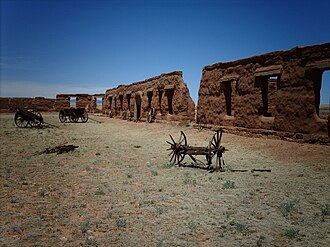
The third and final fort, begun in 1863 and requiring roughly six years to complete, was the most ambitious. It combined a military post, a sprawling quartermaster depot, and an arsenal, all laid out on the open plain in the restrained Territorial style that characterized Anglo-American building in New Mexico after 1846. Walls were raised from adobe bricks manufactured on site, set on stone foundations, and finished with milled-lumber porches, brick coping, and pedimented window and door surrounds shipped overland on the very wagon trains the fort was built to protect. The result was a hybrid: indigenous earthen mass construction dressed with Greek Revival millwork, a defining vocabulary of Territorial architecture.
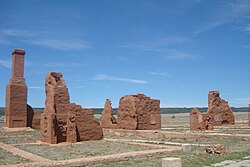
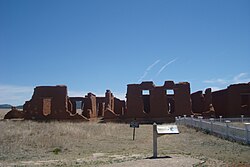
At its height the post supported hundreds of soldiers, teamsters, laundresses, and civilian employees, and supplied military operations across the Southwest until the arrival of the railroad rendered the wagon-road depot obsolete. The Army abandoned the site in 1891, and the unfired adobe walls began their slow return to the earth. Roofs collapsed, lintels fell, and rain reduced ornamented facades to eroding stubs. The National Park Service assumed stewardship after the site was designated a National Monument in 1954, and today preserves the most extensive nineteenth-century adobe military ruins in the United States, including chimneys, wall fragments, and the outlines of barracks, officers' quarters, and the depot complex.
Notable features
- adobe ruinsTerritorial
- Santa Fe Trail siteTerritorial
- three successive fortsTerritorial
- Territorial-style military architectureTerritorial
- National Park Service siteTerritorial
Common questions
What is Fort Union National Monument?
Fort Union National Monument is a National Park Service site in Watrous, New Mexico, preserving the adobe ruins of what grew into the largest U.S. military installation in the nineteenth-century American Southwest. Three successive forts occupied the site between 1851 and 1891 along the Santa Fe Trail.
When was Fort Union built?
Fort Union was established in August 1851 by Lt. Col. Edwin V. Sumner. A second, star-shaped earthen fort was built in 1861 during the Civil War, and the third and final adobe-and-stone fort was begun in 1863 and took roughly six years to complete. The Army abandoned the site in 1891.
Where is Fort Union National Monument located?
Fort Union National Monument is located along NM Highway 161 near Watrous, New Mexico 87753, at the historic convergence of the Mountain and Cimarron branches of the Santa Fe Trail.
Can you visit Fort Union National Monument?
Fort Union National Monument is an open-air heritage site administered by the National Park Service. It was designated a National Monument in 1954 and today preserves the most extensive nineteenth-century adobe military ruins in the United States, including chimneys, wall fragments, and the outlines of barracks, officers' quarters, and the depot complex.
What architectural style is Fort Union?
The third Fort Union was built in the Territorial style, characteristic of Anglo-American building in New Mexico after 1846. Walls were raised from adobe bricks manufactured on site, set on stone foundations, and finished with milled-lumber porches, brick coping, and pedimented window and door surrounds — a hybrid of indigenous earthen mass construction and Greek Revival millwork.
Why is Fort Union National Monument historically significant?
Fort Union was the largest U.S. military installation in the nineteenth-century American Southwest and the principal supply depot for military operations across the region until the arrival of the railroad rendered it obsolete. Today it preserves the most extensive nineteenth-century adobe military ruins in the United States and is NRHP-listed under reference number 66000489.