History
The Leonis Adobe stands at 23537 Calabasas Road in the San Fernando Valley town of Calabasas, occupying a site at the western edge of Los Angeles County that was once part of the Mexican-era Rancho El Escorpion. The building is the principal historic structure associated with Miguel Leonis, a Basque immigrant who arrived in Southern California in the 1850s, married Espiritu Chijulla, a Chumash and Tongva woman whose family had inherited rancho lands at El Escorpion, and built a sheep and cattle empire in the western Santa Monica Mountains and Simi Hills.
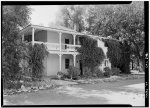
The visible building is a two-story Monterey-style adobe, a form that combines a single-story Mexican rancho ground floor with a second-story addition under a wood-framed gable or hip roof with a continuous covered balcony along the principal elevation. The Monterey form, originating in the Northern California port of Monterey in the 1830s, was widely adopted in Southern California ranchos after statehood as a way to enlarge older one-story adobes to suit larger households and the prevailing American taste for two-story domestic architecture. The walls are laid up from sun-dried adobe brick, plastered, and protected by deep porches; the roof is finished with wood shingles rather than the mission-era clay tile.
After Miguel Leonis's death in 1889 and the long legal battle over his estate, the property passed through several hands before being saved from demolition in the 1960s by local preservationists. It was one of the founding properties of the modern Los Angeles County historic preservation movement and was listed on the National Register of Historic Places in 1975 under reference 75000433.
The building is now operated as a house museum by the Leonis Adobe Association, with interpretive interiors, period livestock, and the adjacent Plummer House on the grounds. Within the broader California adobe tradition, the Leonis Adobe is one of the clearest surviving examples of the Monterey two-story rancho form in Southern California and a key document of the bicultural Californio-Anglo-Basque households that characterized the western San Fernando Valley in the second half of the nineteenth century.
Common questions
What is the Leonis Adobe?
The Leonis Adobe is a historic adobe property in Calabasas, California, listed on the National Register of Historic Places under reference number 75000433. It is documented by the Historic American Buildings Survey as part of the Miguel Leonis Adobe complex on Calabasas Road in Los Angeles County.
When was the Leonis Adobe built?
Construction records for the Leonis Adobe are incomplete. The property is recognized as a historic resource listed on the National Register of Historic Places under reference 75000433 and is documented in the Historic American Buildings Survey.
Where is the Leonis Adobe located?
The Leonis Adobe is located at 23537 Calabasas Road in Calabasas, Los Angeles County, California. The site is documented in the Historic American Buildings Survey records held by the Library of Congress.
Is the Leonis Adobe open to the public?
Yes, the Leonis Adobe operates as the Leonis Adobe Museum in Calabasas, California. The property is recognized on the National Register of Historic Places under reference 75000433. Visitors should consult the museum's current schedule for public-tour information and hours of access.
Why is the Leonis Adobe historically significant?
The Leonis Adobe is significant as a National Register of Historic Places property (reference 75000433) in Calabasas, California. It is documented in the Historic American Buildings Survey, a federal program preserving records of buildings of architectural and historical importance.