History
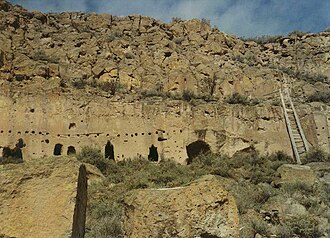
Puye Cliff Dwellings sit atop and along a 200-foot cliff of soft Bandelier tuff on the Pajarito Plateau, roughly ten miles west of Española. The site is the ancestral homeland of the Santa Clara Pueblo people (the Khap'o Owingeh), who consider Puye their direct point of origin in the Tewa world. Although intermittent occupation of the mesa reaches back to the Pueblo II era in the late 10th century, the village as visible today was established in the late 1200s or early 1300s and was largely abandoned by about 1600 as residents resettled along the Rio Grande at the present Santa Clara Pueblo.
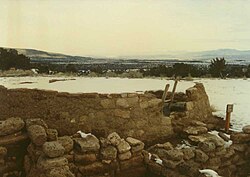
The complex pairs two distinct construction methods that together define the vernacular adobe and stone-masonry tradition of the northern Rio Grande pueblos. Along the cliff face, residents carved approximately 740 rooms directly into the friable volcanic tuff using wooden tools, then extended living space outward with masonry rooms built of cut tuff blocks set in adobe mortar and finished with mud plaster. The lower tier stretches more than a mile along the cliff, with a second tier of about 2,100 feet above it, connected by paths, hand-cut steps, and ladders. Atop the mesa stood a large communal pueblo with hundreds of additional rooms, plazas, and circular kivas used for ceremony. At its peak the settlement is estimated to have housed around 1,500 people, supported by dryland farming of corn, beans, and squash on the mesa and surrounding canyons.
Puye received the first systematic scientific excavation of any prehistoric pueblo in the Rio Grande valley when archaeologist Edgar Lee Hewett, working through the Southwest Society of the Archaeological Institute of America, opened investigations at the site in 1907. Hewett's work helped establish Southwestern archaeology as a discipline and provided early documentation of the masonry, adobe, and tuff construction techniques that would later inform the Pueblo Revival movement.
Puye Cliff Dwellings were designated a National Historic Landmark in 1966 and listed on the National Register of Historic Places under reference 66000484. The site is owned and operated by the Santa Clara Pueblo, which manages it as a museum and guided-tour destination, offering interpretive access to the cliff trails, mesa-top ruins, and reconstructed community house.
Notable features
- cliff dwellings carved from volcanic tuffVernacular Adobe
- mesa-top puebloVernacular Adobe
- kivas and ceremonial spacesVernacular Adobe
- two-tier cliff face complexVernacular Adobe
- approximately 740 roomsVernacular Adobe
- reconstructed community houseVernacular Adobe
Common questions
What is Puye Cliff Dwellings?
Puye Cliff Dwellings is an ancestral pueblo site near Española, New Mexico, set atop and along a 200-foot cliff of Bandelier tuff on the Pajarito Plateau. It is the ancestral homeland of the Santa Clara Pueblo people (the Khap'o Owingeh), who consider it their direct point of origin in the Tewa world.
When was Puye Cliff Dwellings built?
The village visible today at Puye Cliff Dwellings was established around the late 1200s or early 1300s, though intermittent occupation of the mesa reaches back to the Pueblo II era in the late 10th century. The site was largely abandoned by about 1600 as residents resettled at present-day Santa Clara Pueblo.
Where is Puye Cliff Dwellings located?
Puye Cliff Dwellings is located on NM Highway 30 near Española, New Mexico 87532, roughly ten miles west of Española on the Pajarito Plateau.
Can you visit Puye Cliff Dwellings?
Yes, Puye Cliff Dwellings is owned and operated by the Santa Clara Pueblo as a museum and guided-tour destination. It offers interpretive access to the cliff trails, mesa-top ruins, and a reconstructed community house.
Why is Puye Cliff Dwellings historically significant?
Puye Cliff Dwellings was designated a National Historic Landmark in 1966 and listed on the National Register of Historic Places under reference 66000484. In 1907 it received the first systematic scientific excavation of any prehistoric pueblo in the Rio Grande valley, conducted by archaeologist Edgar Lee Hewett.
What architectural features define Puye Cliff Dwellings?
Puye Cliff Dwellings pairs two construction methods: approximately 740 rooms carved directly into the friable volcanic tuff and masonry rooms built of cut tuff blocks set in adobe mortar finished with mud plaster. A two-tier cliff face complex stretches over a mile, with a large mesa-top pueblo containing plazas and circular kivas above.