History
San Miguel Mission stands on ground that has been continuously associated with Franciscan worship since 1626, when missionaries arrived among the Piro Pueblo of present-day Socorro and established Nuestra Señora del Socorro. The original mission, completed around 1627, was built of adobe in the standard pattern used across the Rio Grande corridor: hand-formed mud bricks laid in thick load-bearing walls, with viga-and-latilla ceilings spanning the nave. That first church was abandoned and damaged during the Pueblo Revolt of 1680, when Franciscan missions throughout New Mexico were destroyed or left in ruin. The site remained largely unused for more than a century as the Piro population dispersed southward toward El Paso del Norte.
Resettlement of Socorro began in 1815 under a Mexican land grant, and reconstruction of the church followed shortly afterward. The current structure was raised between 1819 and 1821 on the footprint of the earlier mission, reusing portions of the original foundation. A fragment of the 17th-century adobe wall remains visible inside the building, preserved behind glass near the altar as physical evidence of the colonial-era fabric beneath the later church.
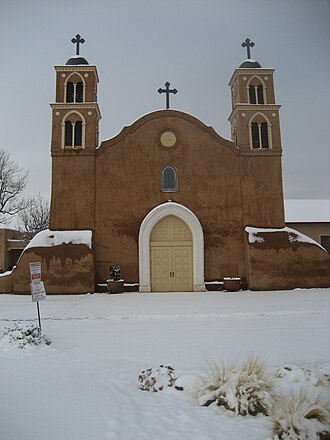
The rebuilt mission follows the Spanish Colonial form common to surviving New Mexican mission churches: a long, narrow nave, exceptionally thick adobe walls plastered with mud, and a flat roof carried on heavy timber vigas. Twin bell towers flank the entrance facade, a configuration that became more emphatic during later 19th- and early 20th-century renovations that introduced Mission Revival detailing to the exterior. Despite successive replasterings and roof repairs, the core walls remain adobe, and the plan retains the cruciform massing characteristic of late Spanish Colonial mission building in the upper Rio Grande.
San Miguel is administered by the Archdiocese of Santa Fe and continues to serve as an active parish church. Manuel Armijo, the last Mexican governor of New Mexico, is interred on the grounds. The property was added to the National Register of Historic Places in 1968 under reference 68000043, and it is recognized as one of the older continuously used adobe church sites in the state, valued for both its standing 1820s fabric and the preserved remnants of the original 17th-century mission embedded within it.
Notable features
- thick adobe wallsSpanish Colonial
- twin bell towersSpanish Colonial
- preserved 17th-century adobe wall fragmentSpanish Colonial
- active parish churchSpanish Colonial
- Spanish Colonial massingSpanish Colonial
Common questions
What is San Miguel Mission?
San Miguel Mission is a Spanish Colonial adobe mission church in Socorro, New Mexico, standing on ground continuously associated with Franciscan worship since 1626. The current structure, built between 1819 and 1821, incorporates the footprint and a preserved fragment of the original 17th-century adobe mission destroyed during the Pueblo Revolt.
When was San Miguel Mission built?
The current San Miguel Mission was raised between 1819 and 1821, around the year 1821, on the footprint of the earlier 1626 mission. The original mission, Nuestra Señora del Socorro, was established by Franciscans among the Piro Pueblo and completed around 1627 before being damaged in the 1680 Pueblo Revolt.
Where is San Miguel Mission located?
San Miguel Mission is located at 403 El Camino Real NW in Socorro, New Mexico 87801, in the upper Rio Grande corridor of central New Mexico.
Can you visit San Miguel Mission?
Yes, San Miguel Mission is administered by the Archdiocese of Santa Fe and continues to serve as an active parish church. Visitors can experience both the standing 1820s adobe fabric and the preserved fragment of the 17th-century adobe wall, displayed behind glass near the altar.
What architectural style is San Miguel Mission?
San Miguel Mission is built in Spanish Colonial style with a long, narrow nave, exceptionally thick adobe walls plastered with mud, and a flat roof carried on heavy timber vigas. Twin bell towers flank the entrance facade, with Mission Revival detailing added during 19th- and early 20th-century renovations.
Why is San Miguel Mission historically significant?
San Miguel Mission was added to the National Register of Historic Places in 1968 under reference 68000043. It is one of the older continuously used adobe church sites in New Mexico, valued for its standing 1820s fabric, preserved 17th-century mission remnants, and the burial of Manuel Armijo, the last Mexican governor of New Mexico.