



History
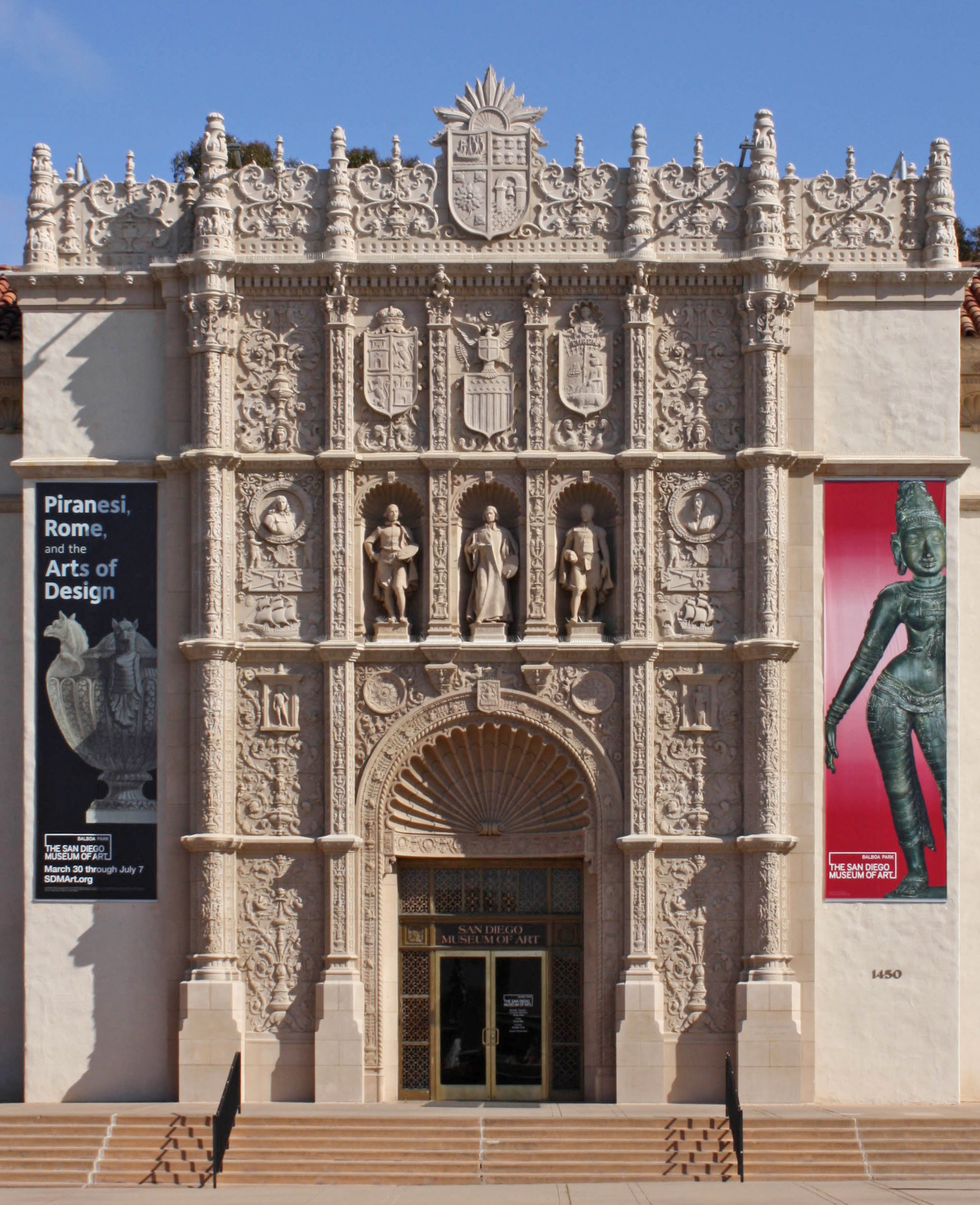
The San Diego Museum of Art occupies a Spanish-colonial revival building at the heart of Balboa Park, the cultural complex developed for the 1915 Panama-California Exposition. The museum building itself was constructed in the 1920s as the permanent fine arts gallery of the park, replacing earlier temporary exposition structures, and was designed in the Plateresque manner that drew on sixteenth-century Spanish precedents.
The building was constructed of reinforced concrete and stuccoed masonry rather than true adobe, but was detailed in the formal vocabulary of Spanish-colonial revival civic architecture. The principal entry facade carries an ornamented cast-stone frontispiece modeled on the Plateresque portals of Spanish Renaissance churches and university buildings, with niches containing figures of Spanish painters. Low-pitched red clay tile roofs, plain plastered side walls, and arcaded interior courtyards complete the regional revival idiom. The building was designed by William Templeton Johnson, working within the architectural framework that Bertram Goodhue had established for the broader park.
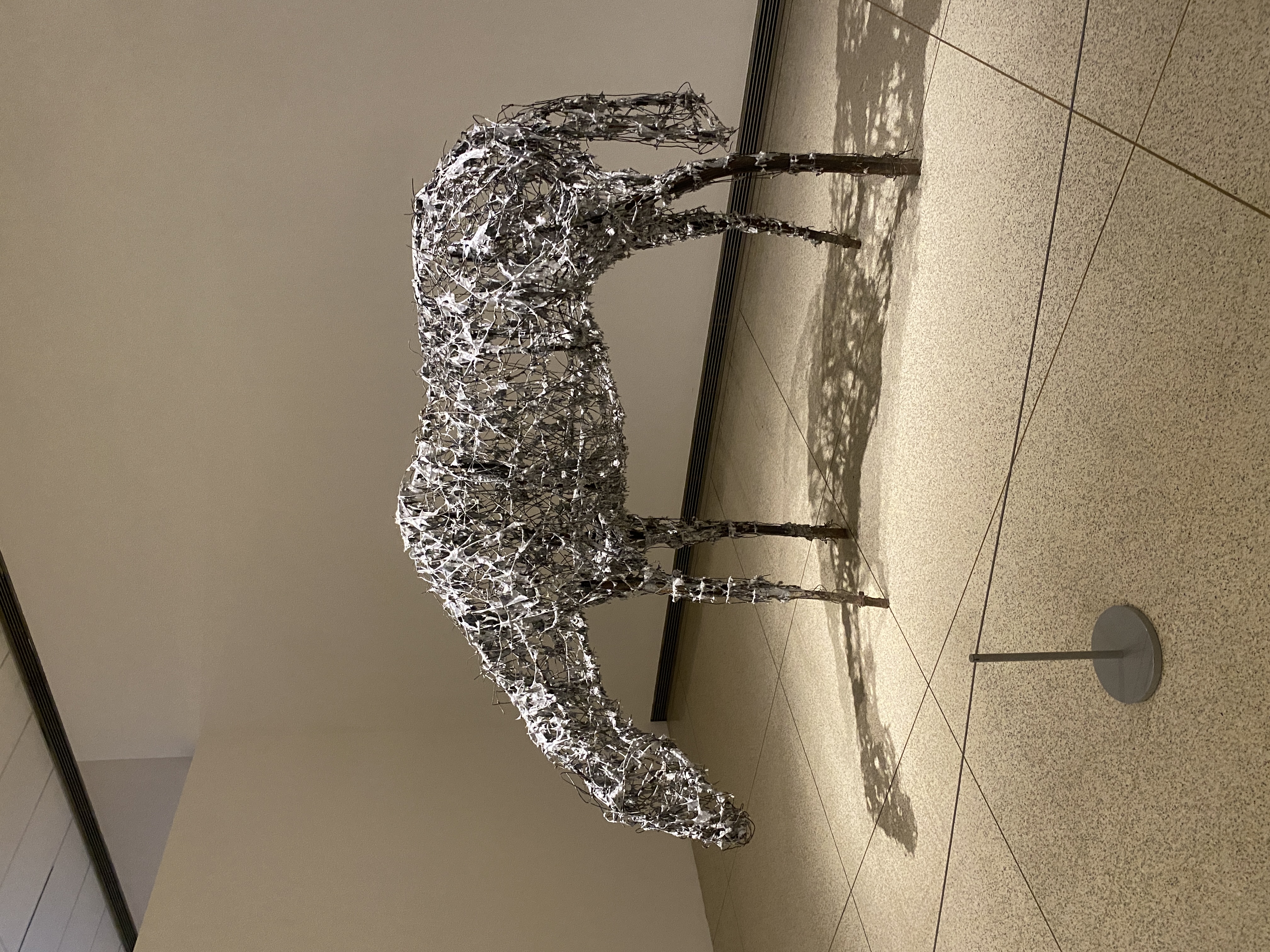
The museum opened in the 1920s and grew to house one of the more important art collections on the Pacific Coast, with particular strengths in Spanish old masters and Asian art. Subsequent additions in the 1960s and later decades extended the gallery and storage space while preserving the original revival facade as the public face of the institution.
The building remains in active institutional use as the principal art museum of San Diego, integrated into the broader Balboa Park cultural campus and stewarded by a nonprofit organization.
Within California's adobe and revival traditions, the San Diego Museum of Art building represents the early-twentieth-century elaboration of the Spanish-colonial revival into its more ornamental Plateresque mode, demonstrating how the regional mission and rancho heritage was reinterpreted through Renaissance Spanish precedents to serve the cultural ambitions of southern California civic life.
Common questions
What is The San Diego Museum of Art?
The San Diego Museum of Art is a fine art museum in Balboa Park in San Diego, California, housing a broad collection with particular strength in Spanish art. The official Balboa Park website calls it "the region's oldest and largest art museum," and it is visited by nearly half a million people each year.
When was The San Diego Museum of Art built?
No precise completion year for the building is preserved in the registry data. The institution opened to the public on February 28, 1926, as the Fine Arts Gallery of San Diego, indicating the structure was completed by that date.
Where is The San Diego Museum of Art located?
The San Diego Museum of Art is located in Balboa Park in San Diego, California.
Can you visit The San Diego Museum of Art?
Yes. The San Diego Museum of Art operates as an active fine art museum in Balboa Park, drawing nearly half a million visitors each year. It is the region's oldest and largest art museum according to the official Balboa Park website.
What architectural style is The San Diego Museum of Art?
The San Diego Museum of Art building is in the Spanish Colonial architectural tradition, in keeping with the broader Balboa Park ensemble of Spanish and Spanish Colonial Revival structures.
Why is The San Diego Museum of Art historically significant?
The San Diego Museum of Art opened on February 28, 1926, as the Fine Arts Gallery of San Diego and was renamed in 1978. It is recognized as the region's oldest and largest art museum and is particularly noted for the strength of its Spanish art collection.