Atlas region IV
The record at a glance
This chapter documents 1 catalogued adobe properties across 1 Florida settlements. The summary at right breaks the catalog down by architectural style, current status, and recorded date range.
A single 1920s Pueblo Revival commercial block on the Atlantic coast — adobe imagery transplanted to a climate that would never have supported the real material.
Where the entries are
A short history of adobe in Florida
Florida is the wrong climate for adobe. The earthen wall depends for its survival on the dry desert summers that bake the plaster hard and the cold winter nights that keep it from re-absorbing groundwater. In a sub-tropical climate the material fails inside a generation. The state’s actual masonry vernacular is coquina (the soft local limestone of St Augustine) and tabby (the lime-and-oyster-shell concrete of the Sea Islands) — both of which the Spanish colonial builders adopted by the 1660s, both of which survive in great numbers, and both of which are properly the subject of their own catalogs.
What Florida does hold, and what this chapter records, is an architectural quotation: a 1920s commercial block in Vero Beach that adopted the Pueblo Revival idiom long-distance, framed conventionally, and finished in stucco-on-frame to look like the Santa Fe Plan landmarks that the Florida East Coast Railway’s tourist promoters had begun to use as the visual shorthand for the American Southwest.
The Pueblo Arcade — Vero Beach, c.1925
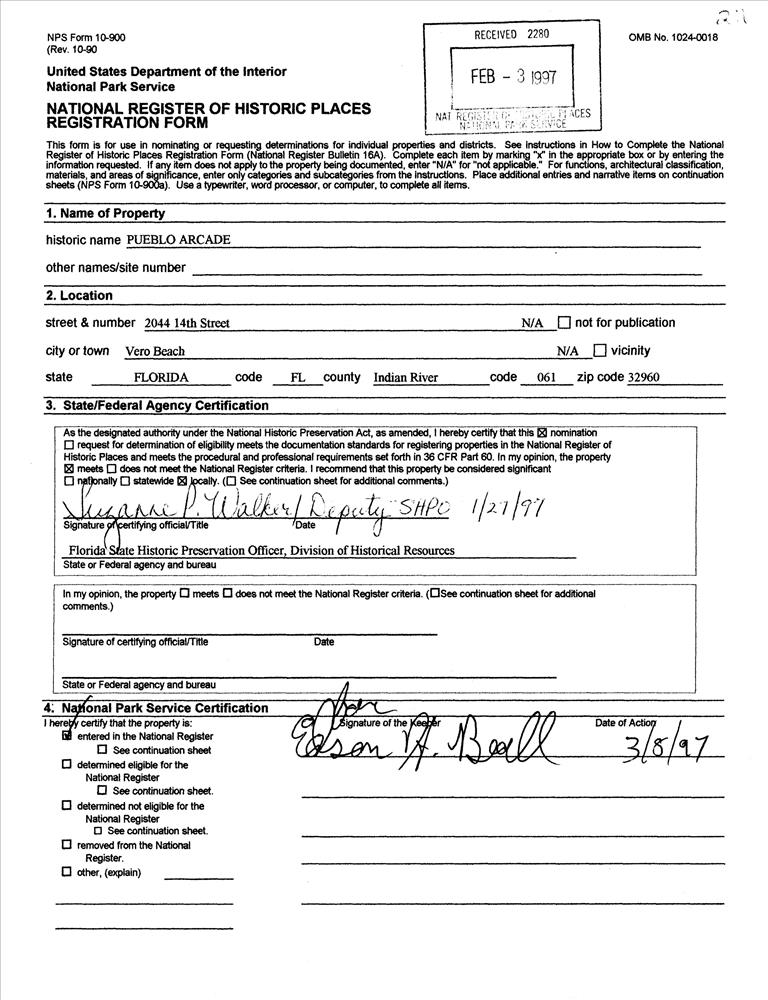
The Pueblo Arcade sits on 14th Avenue in the original Vero Beach downtown grid, two blocks from the railroad station. It is a one-storey commercial block of conventional frame construction with a stuccoed parapet, projecting wooden vigas (decorative, not structural), a stepped façade, and a recessed shop front under a covered portal. It was listed on the National Register in 1997 as a representative example of the Spanish/Pueblo Revival idiom in early 20th-century Florida commercial architecture.
It is a long way from anything that could be called adobe in the technical sense — the walls are wood, not earth — but the building belongs in the catalog because it is a documented surviving example of how the Pueblo Revival vocabulary travelled. The Santa Fe Plan was codified in 1912; the Vero Beach property went up roughly a decade later. The vocabulary was already general property by then.
What is NOT in this catalog
The coquina structures of the St Augustine historic district, the tabby plantation ruins of Amelia Island, the cracker shotgun houses of the Panhandle — none of these are adobe and none are catalogued here, properly recorded elsewhere. The Pueblo Arcade is the single Florida entry on its own merits as a Revival exemplar. Future passes may add a small number of additional Revival commercial blocks from the same period, but the state will never be a deep adobe catalog because the material itself never travelled here in load-bearing form.
Adobes to see in Florida
A short list — ordered roughly by date — drawn from the catalog for first-time visitors. Each entry links to its documented page in the Atlas.
Scroll · drag to explore
Style distribution across Florida
Counts are drawn from the documented record of 1 catalogued entries. Where a building moves between periods, the catalog assigns the style of original construction.
- Vernacular Adobe 1750 – 19501
100%
Cities and villages in Florida
1 settlements hold catalogued entries.
All Florida entries, by city
Every catalogued property in the state, grouped by city in rough order of catalog depth. Tap a card to open the documented entry.