Atlas region III
The record at a glance
This chapter documents 2 catalogued adobe properties across 2 Kansas settlements. The summary at right breaks the catalog down by architectural style, current status, and recorded date range.
A short Mennonite-settler adobe tradition on the south-central plains — earthen building carried in from Russia, used briefly in the 1870s and 80s, then absorbed into the brick farmstead.
Where the entries are
A short history of adobe in Kansas
Kansas adobe is a Mennonite story. The Russian Mennonite migration of 1874 brought several thousand families from the steppe colonies of the Volga and the Crimea to the south-central plains of Kansas, and with them came a building tradition — the same coursed-earth wall, with a thatched or shingle roof, that had served the colonies for a century. The settlers used what they knew. Within a generation they had moved to fired brick from the local clay pits, and adobe disappeared from new construction. The two documented examples in the catalog, the Pioneer Adobe House at Hillsboro and the Thornton Adobe Barn at Isabel, mark the brief overlap.
The Mennonite settler period — c.1874 to 1890
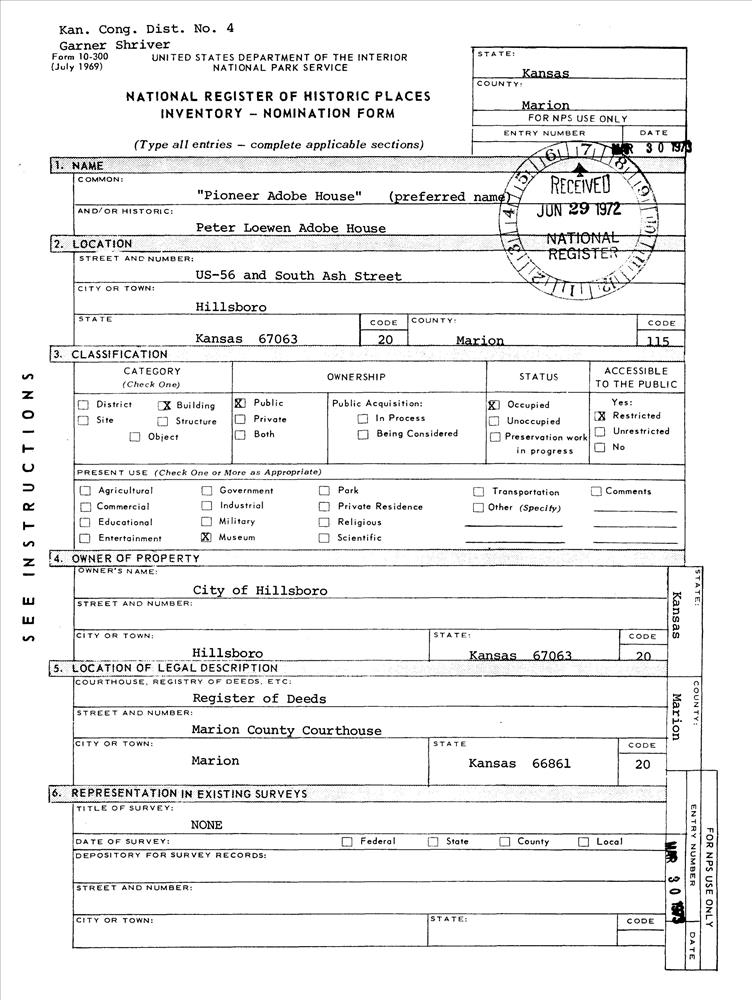
The Mennonites who landed at the rail siding of Peabody and dispersed across Marion and McPherson counties brought turkey-red wheat, the kerosene lantern, and a building practice already adapted to a flat, treeless, periodically-snowed-in landscape. The adobe walls they built were thick — eighteen to twenty-four inches — laid up in coursed brick rather than cob, plastered with a clay-and-straw render, and roofed in milled lumber as soon as the local sawmills could supply it. The plans were practical: a kitchen-and-stove room, a sleeping room, a small parlour where Sunday gatherings could be held. The Pioneer Adobe House at Hillsboro is the Catholic-Mennonite museum’s primary exhibit and the surviving example most readily accessible to visitors.
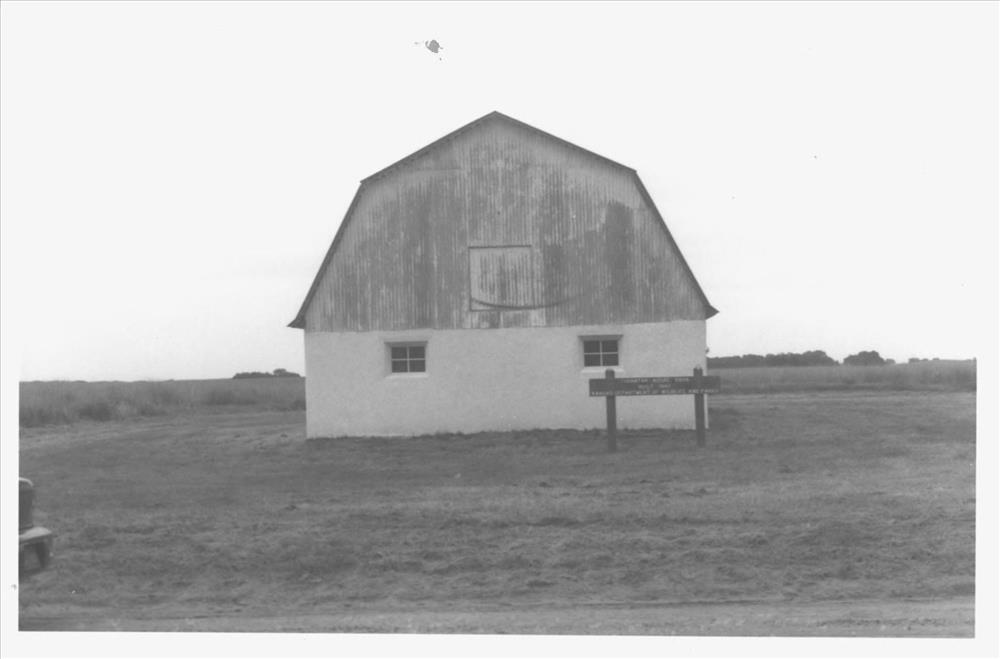
The Thornton Adobe Barn at Isabel records a slightly different tradition — an outbuilding of the same earthen construction, built around 1880 to house cattle through the prairie winter. Adobe barns were uncommon enough on the plains that the Thornton survival was unusual when it was listed in 2003; the wall thickness and the milled-lumber roof are documentary evidence of how the Mennonite settler-vernacular crossed from house to outbuilding before the tradition gave way to wood-frame.
Why the tradition ended
By 1890 the Hillsboro brickyard was producing fired brick at a rate that made adobe obsolete for new construction. The next generation of Mennonite farmhouses — many of them built directly adjacent to the parent adobe — are of red brick with white-painted wood trim, on plans that owe more to the Pennsylvania-Dutch farmstead than to the Russian colony. The adobe houses that survived did so by becoming additions, summer kitchens, or, in the Pioneer Adobe case, museums. The two records below are the documented anchors; further catalogue work in cooperation with the Kansas State Historical Society may surface additional examples from the 1874–1885 window.
Adobes to see in Kansas
A short list — ordered roughly by date — drawn from the catalog for first-time visitors. Each entry links to its documented page in the Atlas.
Scroll · drag to explore
Style distribution across Kansas
Counts are drawn from the documented record of 2 catalogued entries. Where a building moves between periods, the catalog assigns the style of original construction.
- Vernacular Adobe 1750 – 19502
100%
Cities and villages in Kansas
2 settlements hold catalogued entries.
All Kansas entries, by city
Every catalogued property in the state, grouped by city in rough order of catalog depth. Tap a card to open the documented entry.