Atlas region II
The record at a glance
This chapter documents 1 catalogued adobe properties across 1 Utah settlements. The summary at right breaks the catalog down by architectural style, current status, and recorded date range.
A small Mormon-pioneer vernacular preserved in the Wasatch valley towns — adobe used during the brief window between log shelter and milled lumber.
Where the entries are
A short history of adobe in Utah
Utah holds a single catalogued adobe house in the Atlas — the Ebenezer Beesley House of 1866 — and the smallness of the record reflects an architectural history that ran past adobe rather than through it. The Mormon settlers who entered the Salt Lake Valley in 1847 brought a vernacular building tradition from the upper Midwest and the British Isles. Their earliest shelters were log; their first permanent houses were of locally-fired brick wherever a kiln could be raised, and milled stone in the canyons where it was cheaper to cut than to bake. Adobe filled a brief intermediate window, in the years between the log cabin and the first brickyards, when neither of the more durable options was yet available.
The transitional adobe house — c.1850s to 1870s
The houses that did go up in coursed earth during that interval are recognisable by their plan: a single-storey two- or three-room cottage, gable-roofed in the dimensional lumber that the Saw Mill Co-operative made widely available by the late 1850s, with stuccoed exterior walls that conceal the earth core. There are no projecting vigas, no flat parapets, no canales — the Mormon adobe house imitated the eastern frame cottage from the start, and once frame lumber and brick became affordable, adobe was abandoned. Many of the surviving examples were re-skinned in brick by the second generation; the ones that retain visible earth walls are the houses whose owners could not afford the upgrade.
The Ebenezer Beesley House — Salt Lake Valley, 1866
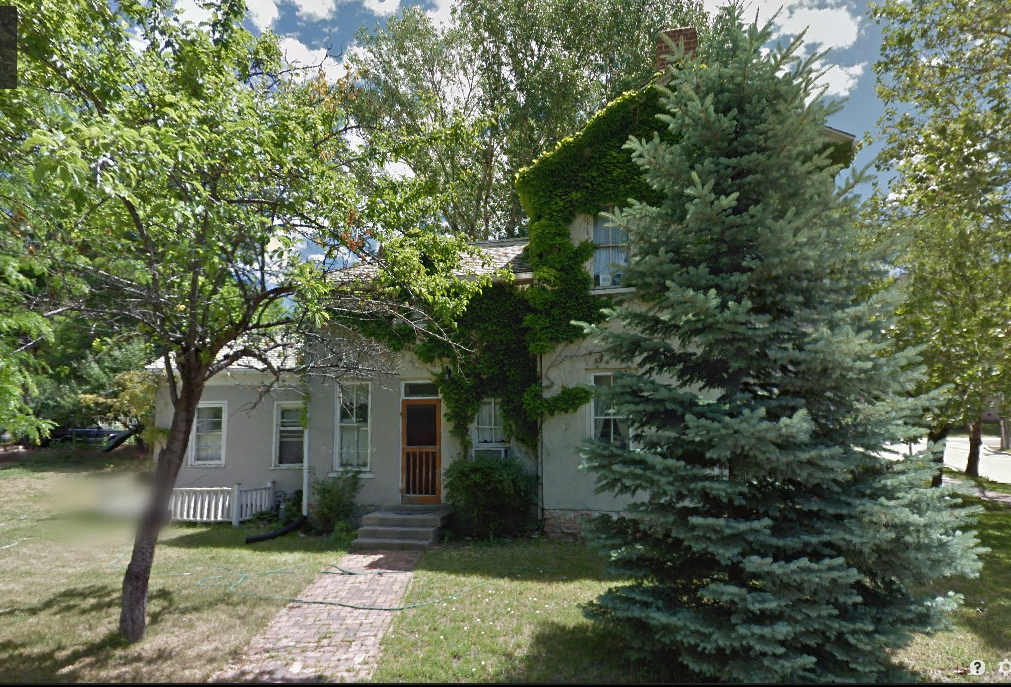
Ebenezer Beesley was a British convert who arrived in Utah in 1859, trained as a musician, and became the conductor of the Salt Lake Tabernacle Choir from 1880 to 1889. His house, built in 1866 during the interval described above, survives as the documented example in the catalog. It is a small two-room adobe cottage of the type that the Beehive Pattern Book of the 1860s recommended for working families, with a later frame addition and a brick chimney that almost certainly replaced an earlier mud-and-stick stack.
Why so few
The catalog’s thinness for Utah is not a failure of preservation but a fact of the state’s building history. The Mormon settlement was unusually well-resourced and unusually fast-moving: by the 1880s every valley town from Logan to St George had a brickyard, and adobe had become identified with the temporary shelters of the trail rather than with the permanent houses of the kingdom. The State Historic Preservation Office has documented additional surviving examples; as their NRHP records are digitised and cross-referenced, the catalog will grow. For now this regional chapter records the Beesley House as the documented anchor of the Utah adobe vernacular.
Adobes to see in Utah
A short list — ordered roughly by date — drawn from the catalog for first-time visitors. Each entry links to its documented page in the Atlas.
Scroll · drag to explore
Style distribution across Utah
Counts are drawn from the documented record of 1 catalogued entries. Where a building moves between periods, the catalog assigns the style of original construction.
- Vernacular Adobe 1750 – 19501
100%
Cities and villages in Utah
1 settlements hold catalogued entries.
All Utah entries, by city
Every catalogued property in the state, grouped by city in rough order of catalog depth. Tap a card to open the documented entry.