History
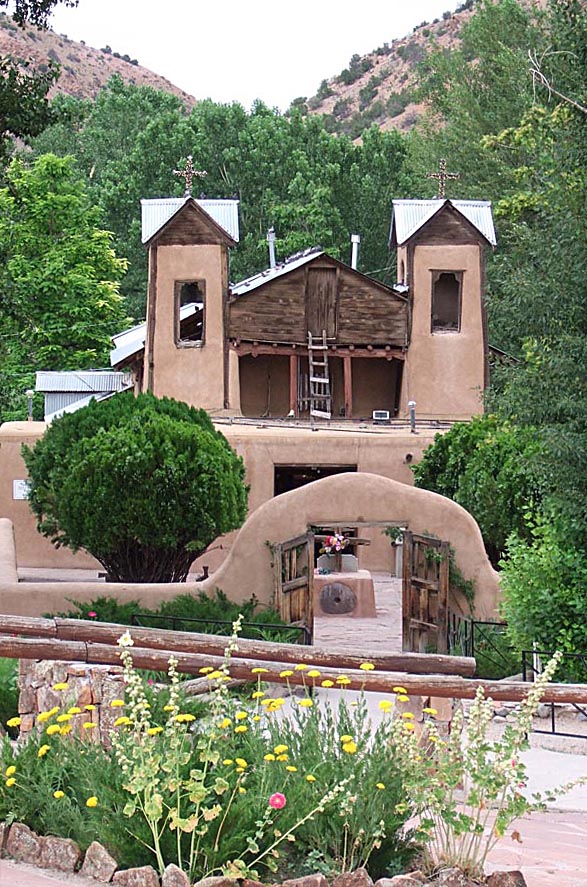
Completed by 1816, El Santuario de Chimayó was built by Don Bernardo de la Encarnación Abeyta, a prominent local rancher and member of the Penitente brotherhood, on a site in the Tewa-named valley of Tsi Mayoh long regarded as sacred by Indigenous and Hispano communities. Abeyta first raised a small chapel around 1810 and replaced it with the present sanctuary within the following six years. The building was dedicated to Our Lord of Esquipulas, a Guatemalan devotion whose iconography traveled north along colonial trade routes, and was later associated with a crucifix said to have been miraculously unearthed at the site.
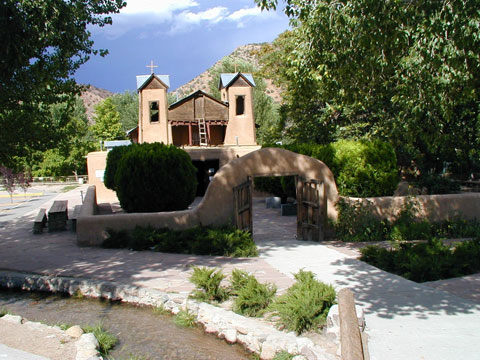
The church is a textbook example of late Spanish Colonial adobe construction on the northern New Mexican frontier. Measuring roughly sixty feet long and twenty-four feet wide, its load-bearing walls of sun-dried adobe brick exceed three feet in thickness, providing thermal mass that moderates the high-desert climate. Small, deep-set windows admit limited light and reduce heat loss, while the heavy timber vigas and corbels supporting the roof reflect Pueblo-influenced carpentry traditions common to mission-era churches in the region. A walled atrium fronts the entrance, and two squat bell towers flank the facade, each capped with a pitched roof added in later renovations. Inside, painted reredos by santero José Aragón and other early nineteenth-century folk artists frame the altar.
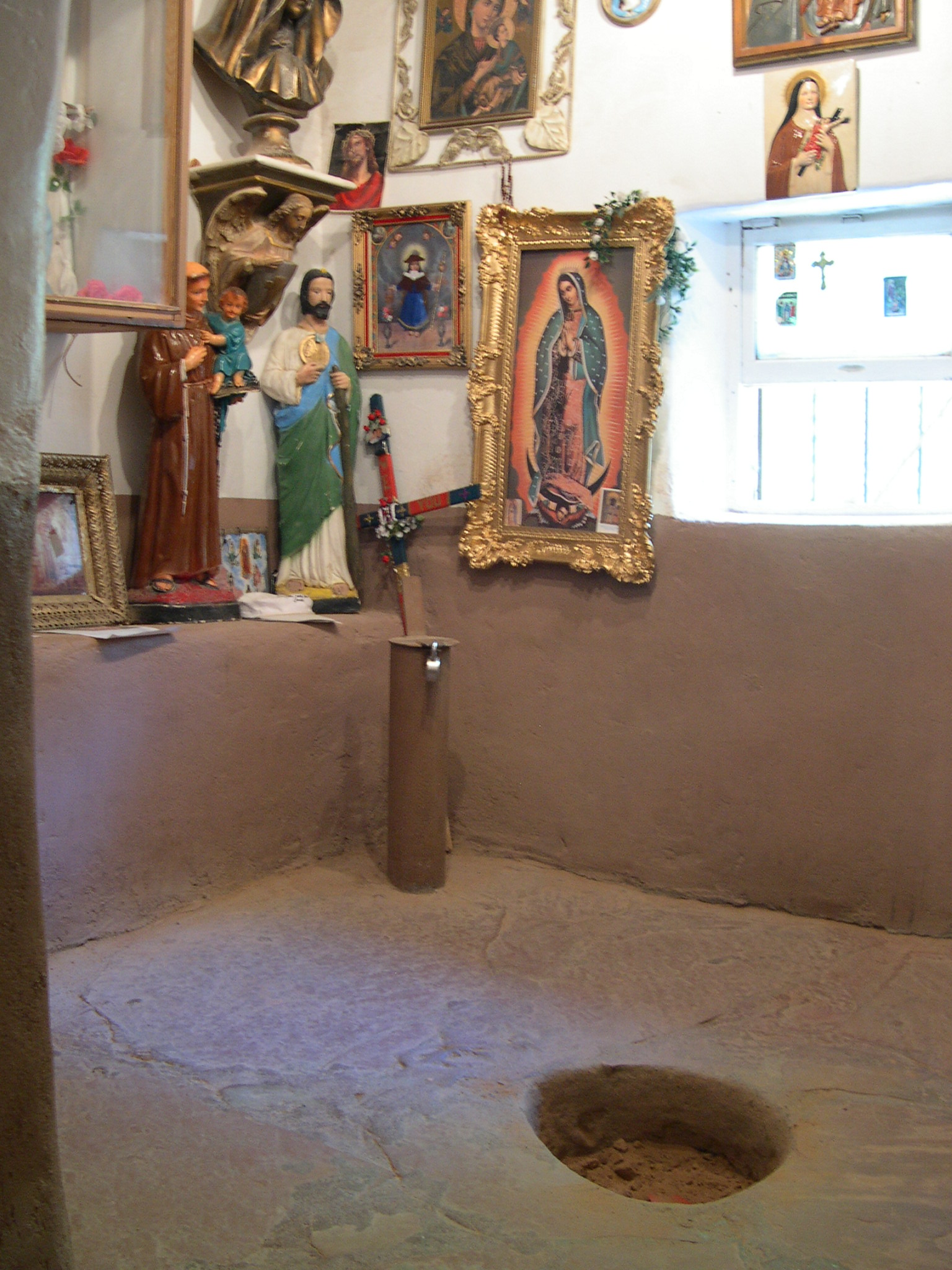
Adjoining the nave is a small side room containing el pocito, a shallow pit of fine earth that pilgrims have, for two centuries, taken away as tierra bendita, or blessed earth, believed by the faithful to carry healing properties. This practice has earned the sanctuary the informal title "the Lourdes of America" and made it one of the most visited Catholic pilgrimage destinations in the United States, drawing an estimated three hundred thousand visitors each year, with the largest gatherings during Holy Week.
The sanctuary remained in the Abeyta family until 1929, when the Spanish Colonial Arts Society purchased the structure and transferred it to the Archdiocese of Santa Fe, which continues to operate it as an active parish church and shrine. El Santuario was listed on the National Register of Historic Places in 1970 and designated a National Historic Landmark the same year, recognized as a singular surviving example of early nineteenth-century Hispano religious architecture and devotional life in the American Southwest.
Notable features
- Three-foot-thick adobe wallsSpanish Colonial
- Twin bell towers with pitched roofsSpanish Colonial
- El pocito (small interior pit of tierra bendita)Spanish Colonial
- Hand-carved reredos and santosSpanish Colonial
- Walled courtyard entrySpanish Colonial
- Active Catholic pilgrimage siteSpanish Colonial
Common questions
What is El Santuario de Chimayó?
El Santuario de Chimayó is a historic Spanish Colonial adobe church and active Catholic shrine in Chimayó, New Mexico. Dedicated to Our Lord of Esquipulas and famed for its small interior pit of tierra bendita, it is among the most visited Catholic pilgrimage destinations in the United States, drawing an estimated three hundred thousand visitors each year.
When was El Santuario de Chimayó built?
El Santuario de Chimayó was completed by 1816. Don Bernardo de la Encarnación Abeyta first raised a small chapel around 1810 and replaced it with the present sanctuary within the following six years on a site long regarded as sacred by Indigenous and Hispano communities.
Where is El Santuario de Chimayó located?
El Santuario de Chimayó is located at 15 Santuario Drive in Chimayó, New Mexico 87522, in the Tewa-named valley of Tsi Mayoh in northern New Mexico.
Can you visit El Santuario de Chimayó?
Yes. El Santuario de Chimayó operates as an active parish church and pilgrimage shrine under the Archdiocese of Santa Fe, which acquired the property from the Abeyta family in 1929. The largest gatherings occur during Holy Week, when pilgrims travel from across the region.
Who built El Santuario de Chimayó?
El Santuario de Chimayó was built by Don Bernardo de la Encarnación Abeyta, a prominent local rancher and member of the Penitente brotherhood. Painted reredos by santero José Aragón and other early nineteenth-century folk artists frame the altar inside.
Why is El Santuario de Chimayó historically significant?
El Santuario de Chimayó was listed on the National Register of Historic Places in 1970 and designated a National Historic Landmark the same year. It is recognized as a singular surviving example of early nineteenth-century Hispano religious architecture and devotional life in the American Southwest.