Atlas region IV
The record at a glance
This chapter documents 1 catalogued adobe properties across 1 District of Columbia settlements. The summary at right breaks the catalog down by architectural style, current status, and recorded date range.
A single documented experimental adobe structure — included as an outlier and a documentary record of how the federal government investigated earthen building outside its native climate.
Where the entries are
A short history of adobe in District of Columbia
The District of Columbia has no adobe tradition. The single entry in this catalog is a temporary experimental structure that the federal government raised — and later removed — as part of a documentary investigation into earthen building. It is included here for completeness, because the structure was extensively photographed by the Historic American Buildings Survey, and because the existence of the record is itself informative about how the material crossed from regional vernacular into federal building science.
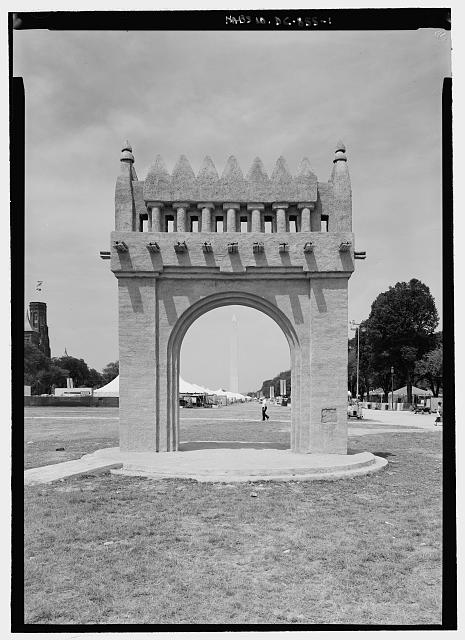
The experimental adobe structure
The structure was a small single-room building, raised on a poured concrete pad and constructed in coursed adobe of locally-mixed clay and straw. Its purpose was research: investigators wanted to document the weathering behaviour, thermal performance, and structural-loading characteristics of an adobe wall in a humid Mid-Atlantic climate, with the goal of producing reference data for the Federal Housing Administration’s evaluation of stabilised-adobe construction as an option for low-cost rural housing programmes in the West.
The HABS photographs survive (eight in the catalog) and document the wall assembly in close detail — the brick courses, the wooden door and window frames, the un-plastered exterior surface that the investigators left exposed deliberately so that the weathering could be photographed over time. The structure was not a house, was never occupied, and was demolished after the documentation was complete.
Why it is in the catalog
The Adobe Atlas records “every historic adobe house in the United States” as its scope. A temporary experimental research structure is not a house. We have catalogued the entry anyway because the HABS record is unusually thorough, because the photographs are useful reference for understanding the wall assembly visible in field-documented examples in the southwestern states, and because the entry is a documentary anchor for how an earthen building tradition becomes the subject of federal study at the point where it begins to disappear from active practice.
Treat this chapter as an annotation rather than a regional treatment. There is no DC adobe tradition; there is one documented research artifact, and the record is preserved here.
Adobes to see in District of Columbia
A short list — ordered roughly by date — drawn from the catalog for first-time visitors. Each entry links to its documented page in the Atlas.
Scroll · drag to explore
Style distribution across District of Columbia
Counts are drawn from the documented record of 1 catalogued entries. Where a building moves between periods, the catalog assigns the style of original construction.
- Vernacular Adobe 1750 – 19501
100%
Cities and villages in District of Columbia
1 settlements hold catalogued entries.
All District of Columbia entries, by city
Every catalogued property in the state, grouped by city in rough order of catalog depth. Tap a card to open the documented entry.