History
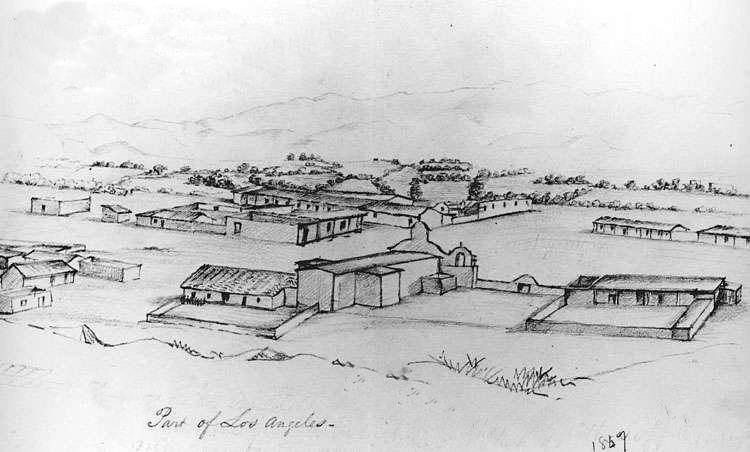
The Nuestra Senora Reina de los Angeles Asistencia, known locally as the Old Plaza Church or La Placita, stands on the north side of the original plaza of the Pueblo de Los Angeles, the founding civic core of the city. The settlement was established by Spanish colonial authorities in 1781 with the small group of mixed-race pobladores from Sonora and Sinaloa who became the original residents of the pueblo. A chapel was first built near the site in the early 1780s, and the present church, completed in the early decades of the nineteenth century, served as an asistencia of the larger Mission San Gabriel until the pueblo was made an independent parish.
Architecturally the building is a Spanish Colonial church. The principal walls were originally laid up from sun-dried adobe brick produced on or near the site, set on a stone foundation, and finished with lime plaster. The plan is a simple aisle-less nave with a flat-fronted facade flanked by a small bell tower or campanario, the standard form of the small Spanish frontier chapels of the late eighteenth and early nineteenth centuries. The structure has been repaired, reroofed, and partially rebuilt several times since the 1810s, with notable nineteenth- and twentieth-century interventions, but the core fabric continues to represent the original Spanish-era pueblo church.
The church served as the principal Catholic parish of Los Angeles through the Spanish, Mexican, and early American periods and remains an active parish today, anchoring the El Pueblo de Los Angeles Historic Monument, the protected historic district that preserves the surviving core of the original Spanish pueblo around the old plaza.
The building is owned by the Archdiocese of Los Angeles and continues in active religious use rather than as a museum, though the surrounding plaza and historic monument are publicly accessible. Within the broader California adobe tradition, the Old Plaza Church is the surviving religious anchor of the original Spanish pueblo of Los Angeles and one of the principal documents of the late-eighteenth-century introduction of mission-style adobe construction to the Los Angeles basin.
Common questions
What is Nuestra Señora Reina de los Ángeles Asistencia?
Nuestra Señora Reina de los Ángeles Asistencia was a Spanish Colonial sub-mission, or 'asistencia,' established in the Pueblo de Los Ángeles to support the nearby Mission San Gabriel Arcángel. It served the early Spanish-era settlement adjacent to the Tongva village of Yaanga.
When was Nuestra Señora Reina de los Ángeles Asistencia built?
Nuestra Señora Reina de los Ángeles Asistencia was founded in early 1784 in the burgeoning Pueblo de Los Ángeles. The original asistencia fell into disuse over time, and a Catholic chapel, La Iglesia de Nuestra Señora Reina de los Ángeles, was constructed in its place roughly thirty years later.
Where is Nuestra Señora Reina de los Ángeles Asistencia located?
Nuestra Señora Reina de los Ángeles Asistencia was located in what is now central Los Angeles, California, in the area of the original Pueblo de Los Ángeles. The site sits near the historic plaza district of downtown Los Angeles.
Can you visit Nuestra Señora Reina de los Ángeles Asistencia?
The original asistencia fell into disuse and was succeeded by a chapel built roughly thirty years after its founding. Visitors interested in the site should consult sources for the surviving church, La Iglesia de Nuestra Señora Reina de los Ángeles, in the Los Angeles Plaza district.
What architectural style is Nuestra Señora Reina de los Ángeles Asistencia?
Nuestra Señora Reina de los Ángeles Asistencia was built in the Spanish Colonial style, the dominant architectural tradition of California's mission-era buildings. The asistencia was constructed as a sub-mission to Mission San Gabriel Arcángel under the Spanish colonial church system.